Ibn Yusuf (Ben Youssef) Madrasa
Updated: Jan 2
The sixteenth century Madrasa built by Sultan Abdullah Assaadi in Marrakech was an ancient destination for scholars in various fields including religious sciences.
It is a stunning monument to visit. The visit costs a ticket priced at about $5.

The entrance is very ornate, and it gets more and more beautiful as one goes inside the Madresa.

The Ibn Yusuf Madrasa is considered as a historical treasure and a testament to the genius of Moroccan ancestors in architecture and decoration.

Located in the central courtyard is an oblong basin about 28 x 12 feet which served as a passive evaporative cooling device in the madrassah. The basin is enhanced with two intricately crafted bronze water jets, facing each other along the axis of symmetry. The floor of the basin and its facades are covered with zellige tiles arranged in a regular checkerboard pattern.
Their unique charm lies in the contrasting alternation of black and white colors, accentuated by a series of brown tiles scattered throughout to break any monotony.

The madrasa has 136 rooms spread across its ground floor and upper floor, a prayer hall, a courtyard, and an ablution room. It is an architectural masterpiece showcasing rich and diverse motifs, vibrant colors, and joyful forms of Moroccan creativity.

The ceramic tiles known as Zellige represent a traditional Moroccan art with complex and refined forms and combinations. They reflect the ingenuity of artisans who have brought to light the beauty of this medersa.

This madrasa has been restored by King Mohammed VI with the help of specialists in sciences, history, archaeology, engineering, and traditional-craftsmen (maallams) who excel in rehabilitating the madrasa using inherited techniques.
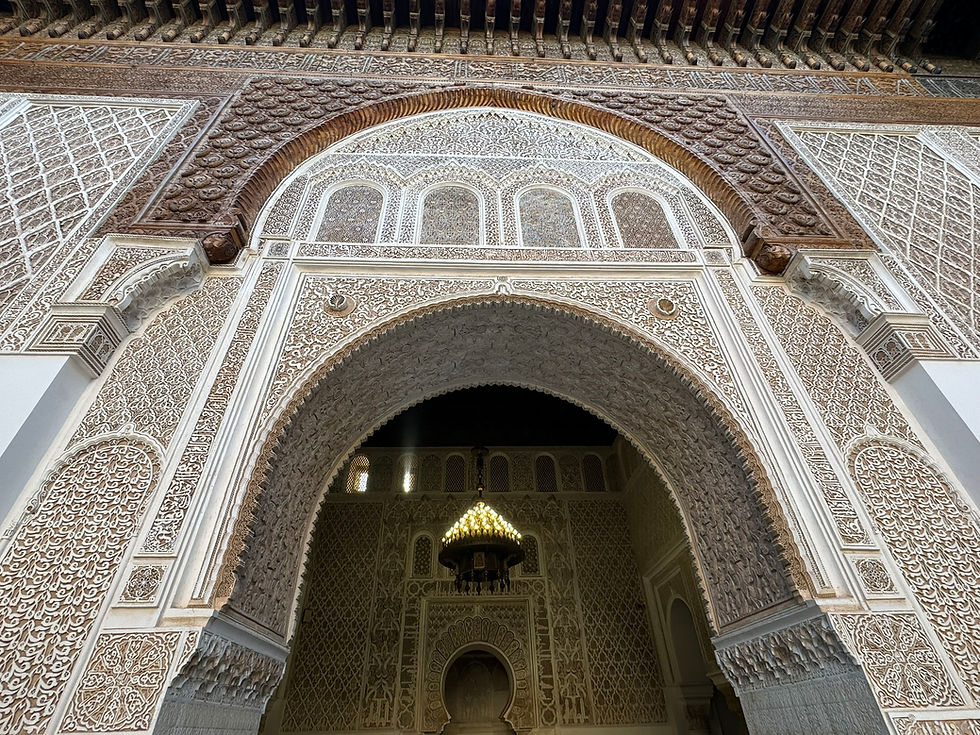
All the doors have intricate carvings on them.

The zellige used in the decoration of the medersa has a thickness of 3 cm, double the conventional thickness. This panel, preserved as a relic and testament after the restoration of the medersa, showcases a pattern often employed in monuments from the Saadian era known as "attarssie".

The Student Rooms are a place of learning and living, and the Medersa fulfills its accommodation function for students with 134 small rooms arranged around 13 courtyards, primarily located on the east and west sides of the building; 54 on the ground floor and 80 on the upper floor.

The student rooms were furnished with everyday objects and meticulously arranged. The reading area is adjacent to the window, and the resting space (wooden alcove) is in the darker part.

The large central courtyard had many activities that took place there, such as the recitation of the Quran. The courtyard takes on a rectangular shape, stretching 70 x 50 feet. To the east and west of the patio, two porticos with sturdy pillars, perfectly symmetrical, face each other. They serve as both complement to the open-air courtyard and as a shelter from the sun and bad weather.
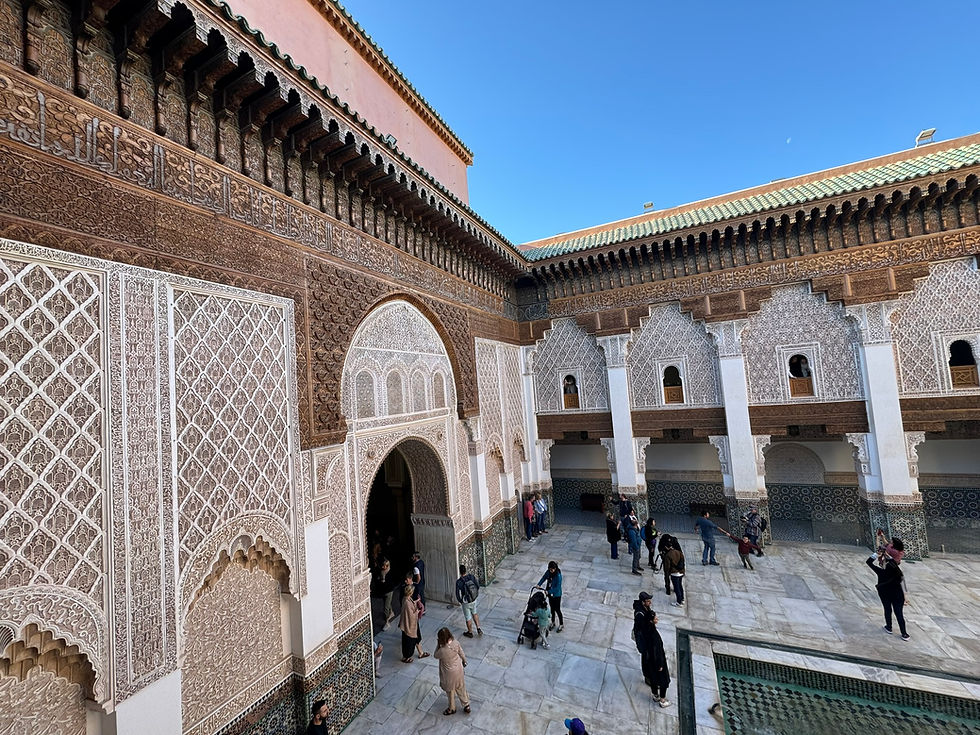
On the upper floor, there are beautiful windows showings views of the courtyard and allowing the space to have a very open feel.
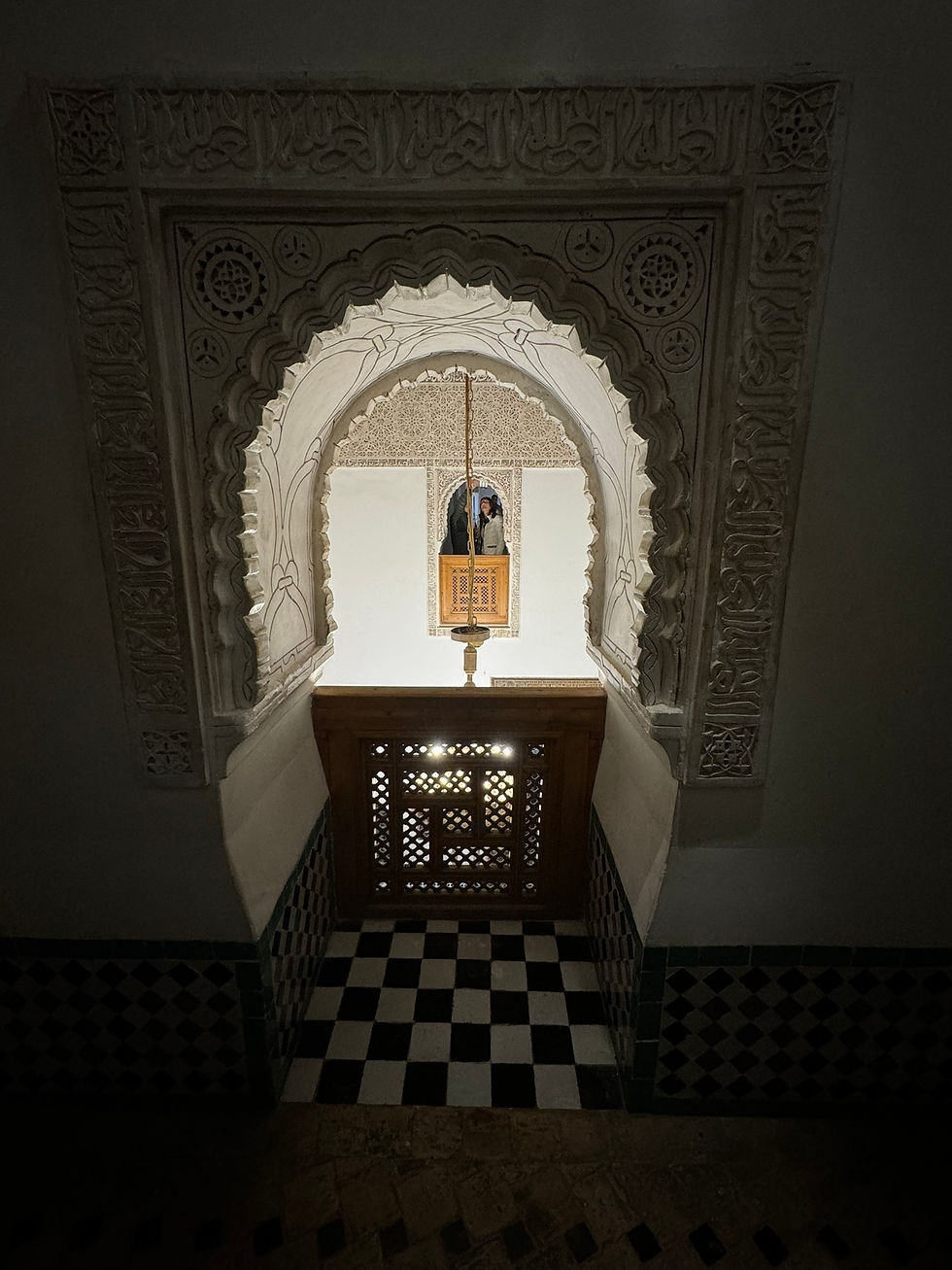
From the corridor, you can see the main entrance of the building, as well as the beautiful chandelier.

The roof holding the chandelier has a very ornate design.

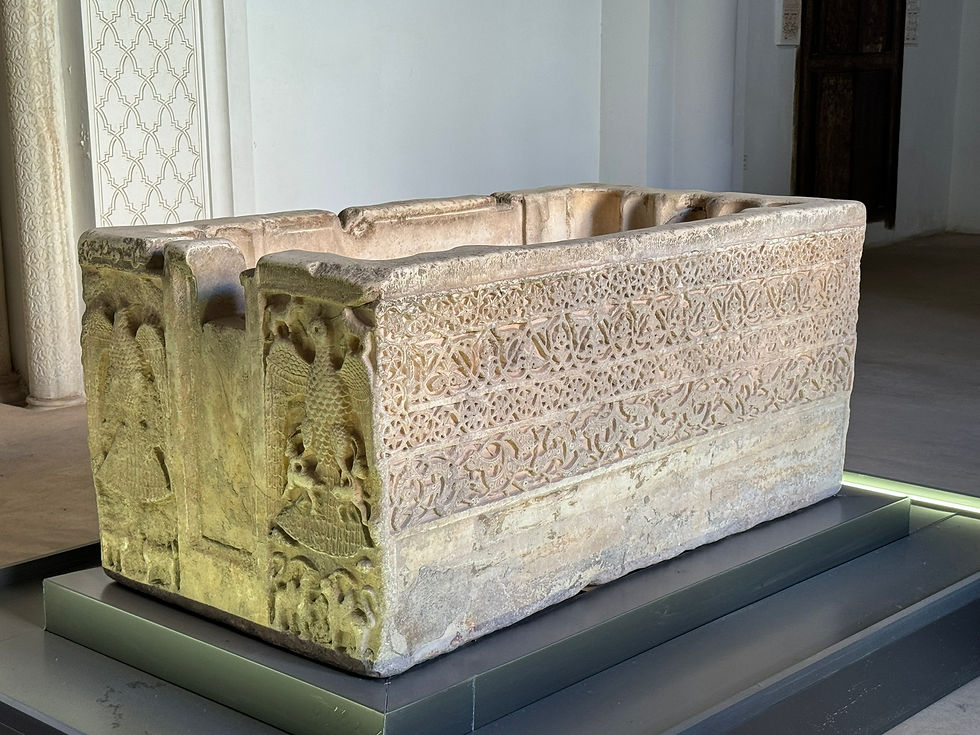
The Ablution Basin served as a vessel for a fountain used for ablutions. Its has a Kufic inscription showing the name of its patron, "Abd-al Matik," son of the powerful Andalusian vizier "Al Mansour (978-1002).
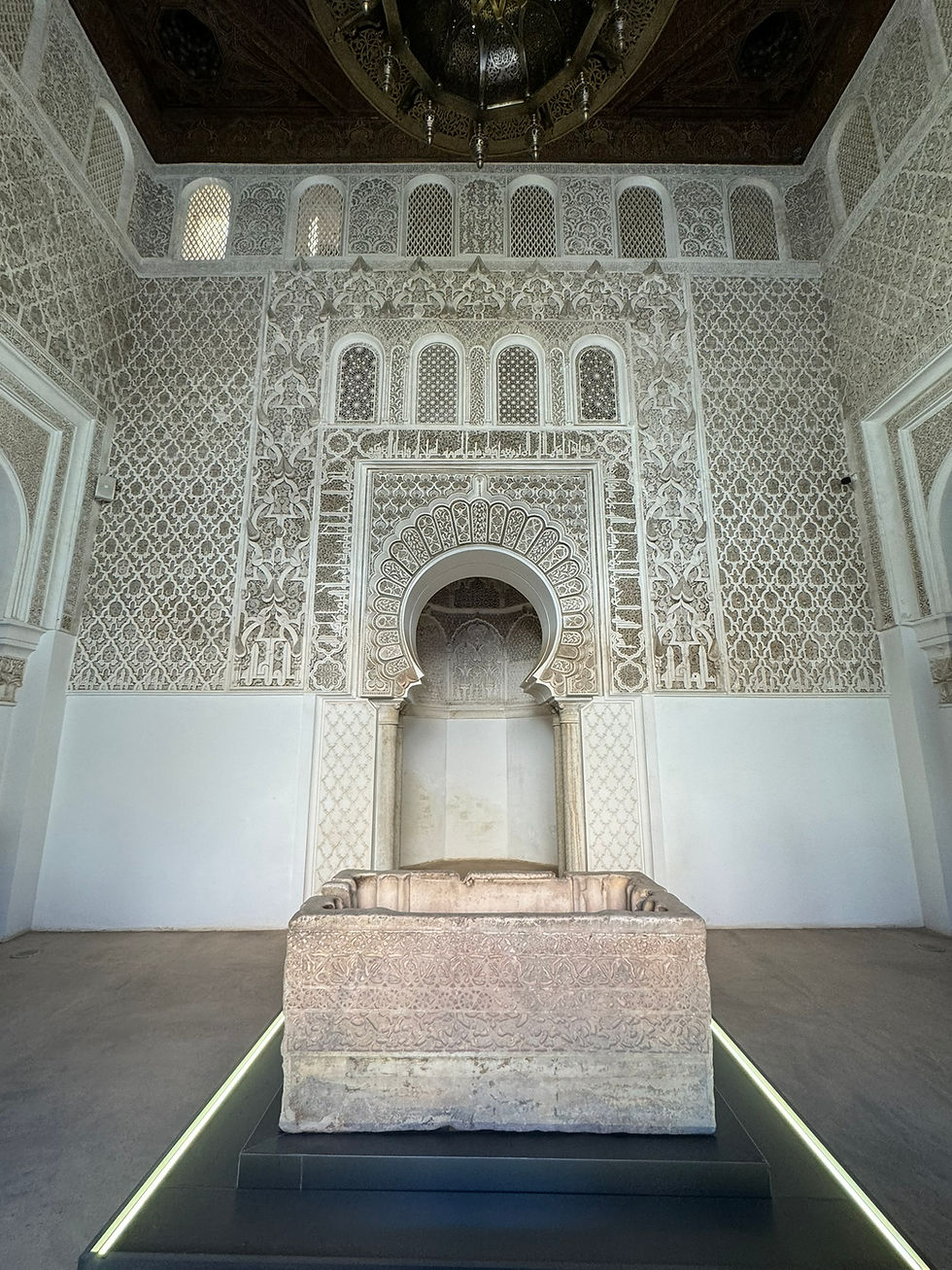
The basin is adorned with floral and geometric motifs, and numerous animals from Andalusia are seen including birds and fish.
The Prayer Hall is a rectangular area measuring 50 feet x 25 feet. It is divided into three aisles, the central aisle is wider than the others and square shaped. The entire space is adorned with sculpted plaster, featuring ornamental designs inspired by flora, geometry, and epigraphy.

The entrance to the prayer hall has two marble panels with intricate decorations. The arch closing the entrance bay is embellished with palm leaves and pineapples. The pentagonal Mihrab's arched frame is decorated with palm leaves and intertwining floral motifs.

The prayer hall floor is paved with a Dass, a common type of covering used in places of worship in Marrakech.

A beautifully decorated place of worship with intricate designs, Ben Yusuf madresa is a very artistic monument, which I enjoyed visiting thoroughly.


Comments