Mt. Tujuh in Kerinci
I’ve wandered across many of Indonesia’s islands — Bali, Java, Lombok, Komodo, and the Gili chain — each with its own rhythm and charm. Java, of course, carries the weight of the nation, a densely packed hub where most of Indonesia’s people live and work. Yet what I longed for was something wilder: Sumatra, that vast, untamed island stretching across the equator, lightly populated and brimming with mystery.

I had originally signed up to climb Mount Kerinci, Indonesia’s highest volcano at 3,805 meters (12,484 feet), a towering giant in the heart of Sumatra. The expedition was planned as a four‑day trip, with two days of actual hiking and the rest for travel. To get there, I first needed to fly from Jakarta in Java to Padang in Sumatra, where the organizers had promised to pick me up.

But just a couple of days before departure, news arrived: Kerinci was closed due to recent volcanic activity. Instead, they offered me an alternative, a trek to Mount Tujuh, home to the highest caldera lake in Southeast Asia.

Trip.com notified me that my 9 a.m. flight had been “changed,” though the update only showed a new flight number, not a new time. I accepted the change, and the app promptly displayed a 1 p.m. departure instead. When I tried to check in online, however, the system insisted the flight was still at 9 a.m. Not wanting to gamble, I arrived at the airport by 7 a.m. and, sure enough, boarded the 9 a.m. flight: same schedule, new number. A little strange, but in the end, it worked perfectly for my plans.
Two hours later, I landed at Padang airport and admired the local musicians performing as a way to welcome to travelers. I was met by the driver, who immediately suggested we stop for lunch. I agreed, but the restaurant he chose was closed temporarily for Friday prayers.
From the backseat, I admired the traditional buildings in this region have striking multi‑curved roofs, their sweeping lines rising and dipping like waves — a signature style of Minangkabau architecture.
We pressed on, hoping to find another place along the way. Soon after, traffic ground to a halt at a highway construction site. The heat and humidity pressed down as the driver switched off the engine and air‑conditioning, then stepped out to wait. An hour passed before the road opened again. Yet even with the delays, the drive was beautiful: lush rainforest, towering trees, and endless shades of green. I didn’t mind; the scenery more than compensated for the wait.
About three hours into the eight‑hour drive, we came across a coffee shop called Radjo, perched on a hill overlooking a beautiful lake where jet skis skimmed across the water. The place was lively, filled with people enjoying local Sumatran coffee and the promise of food. To my chagrin, however, the kitchen had stopped serving meals, and the day was shaping up to be one of fasting instead.
For the next five hours, the driver pressed on while I drifted in and out of sleep. At one point I woke to find myself surrounded by endless tea plantations, their neat green rows stretching as far as the eye could see. Visitors wandered the lanes, pausing to take photographs among the shimmering leaves. I stepped out briefly to capture a few shots of my own before nodding off again.
When I finally awoke, the car had pulled up at the hotel. Eleven hours had passed, and we had covered just 203 kilometers along Sumatra’s winding roads.
Luckily, I had packed my own superfood: a pouch of crunchy salted cashews. I polished off the entire pack during the long drive, which left me content enough to collapse into bed. By the time I woke, breakfast was waiting and the 9 a.m. pickup for the hike was just around the corner.
At the trailhead gate, I joined my small team: a guide, a cook, and a porter. Officials checked my passport, stamped the paperwork, and with that formality complete, we set off into the rainforest.

The rainforest did not disappoint. It was instantly green, dense, and humid. A weathered, fading sign marked the entrance to Kerinci Seblat National Park, a reminder that I was now walking into one of Sumatra’s wildest corners.
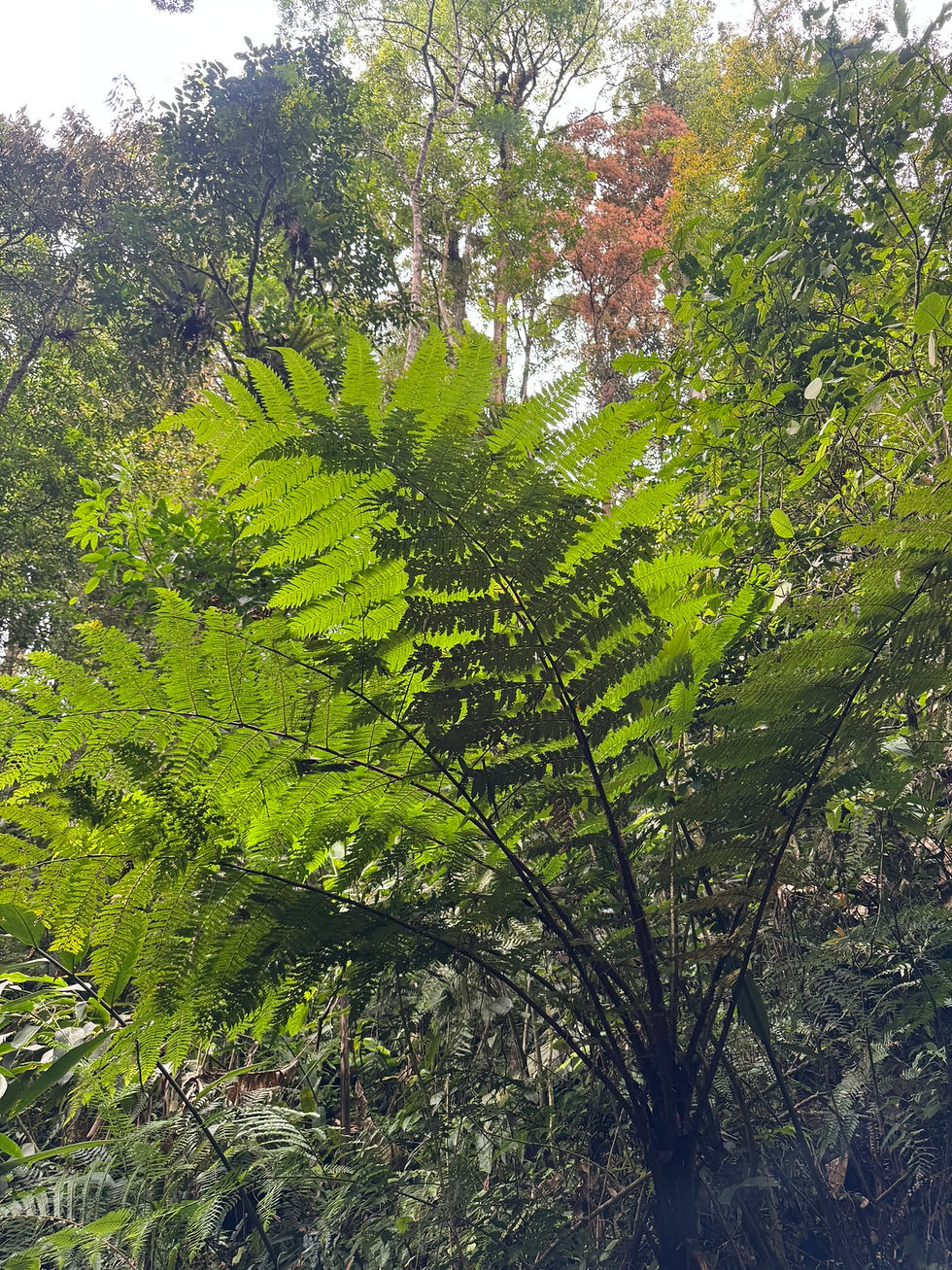
Big, beautiful ferns unfurled in every direction, their broad fronds arching gracefully over the trail and adding to the rainforest’s lush, almost primeval atmosphere.

However, the hike soon revealed its true colors—muddy ones. The trail was a relentless series of steep climbs, each coated in slick, slippery earth that turned every step into a careful negotiation. Progress was slow, and balance became as important as stamina.
I was just glad my pack weighed only six kilos, unlike my porter, who shouldered a far heavier load up those unforgiving slopes.

The network of tree roots was both a blessing and a curse. On the one hand, they formed a kind of natural staircase, giving the climb shape and rhythm. On the other, a misplaced step on the slick wood could send you sliding into a nasty fall.

Nature has its ways of reminding you who’s in charge. The red mushrooms I spotted along the trail were a warning sign in themselves. My guide explained that edible mushrooms usually attract insects or flies, but these vivid red ones stood untouched, a clear signal to keep my distance.
Later, as I sat down to rest, a wide, long centipede with fiery red legs, the notorious Scolopendra subspinipes, one of Southeast Asia’s largest centipedes (or scolopendra dehaani) crawled past me and disappeared into a nearby hole. It made me shudder.

Soon I reached a marker labeled Pos 1. Two more checkpoints lay ahead before the highest point of the hike, each one a step deeper into the rainforest and closer to the summit.
Walking toward Pos 2, the forest suddenly filled with loud, incessant howling. At first it was disorienting, but then I realized these were siamangs, the great howler gibbons of Kerinci. Their calls echoed across the canopy, a wild chorus that seemed to announce our presence in their territory.
At first I couldn’t see them, but my guide asked if I wanted to. Of course, I said yes. He drew his machete, motioned for me to follow, and we slipped off the main trail onto an untrodden path. Soon enough, high above us, groups of siamangs leapt from branch to branch, their movements almost orangutan‑like, wild and fluid against the backdrop of the rainforest.

The moss, epiphytes, ferns, and humongous buttress‑rooted trees never ceased to amaze me as I continued toward Pos 2. Their vast, web‑like roots spread across the forest floor like natural fortifications, a reminder of how rainforest giants hold their ground in such fragile soil.

As I reached a spot filled with a beautiful variety of ferns and epiphytes — some with long, narrow leaves stretching skyward — I noticed a couple of young hikers. They seemed shy at first, but when I smiled and greeted them cheerfully, they asked if I would take a picture with them. I was happy to oblige. Soon, this became a pattern for the rest of the trip: people, young and old alike, curious about where I was from and eager to pose for photos. I enjoyed the attention; it added a lighthearted, human touch to the journey

At Pos 2, a weathered sign in Bahasa displayed the faded image of a tiger. My guide pointed to it and mentioned that he had once seen Sumatran tiger paw prints along the trail. I was skeptical — I had thought the tiger was extinct — but the possibility lingered in my mind as we continued deeper into the forest.
Later I read that Kerinci Seblat still shelters the last great population of Sumatran tigers. Rarely seen, but very much alive, they remain the rainforest’s most elusive guardians.
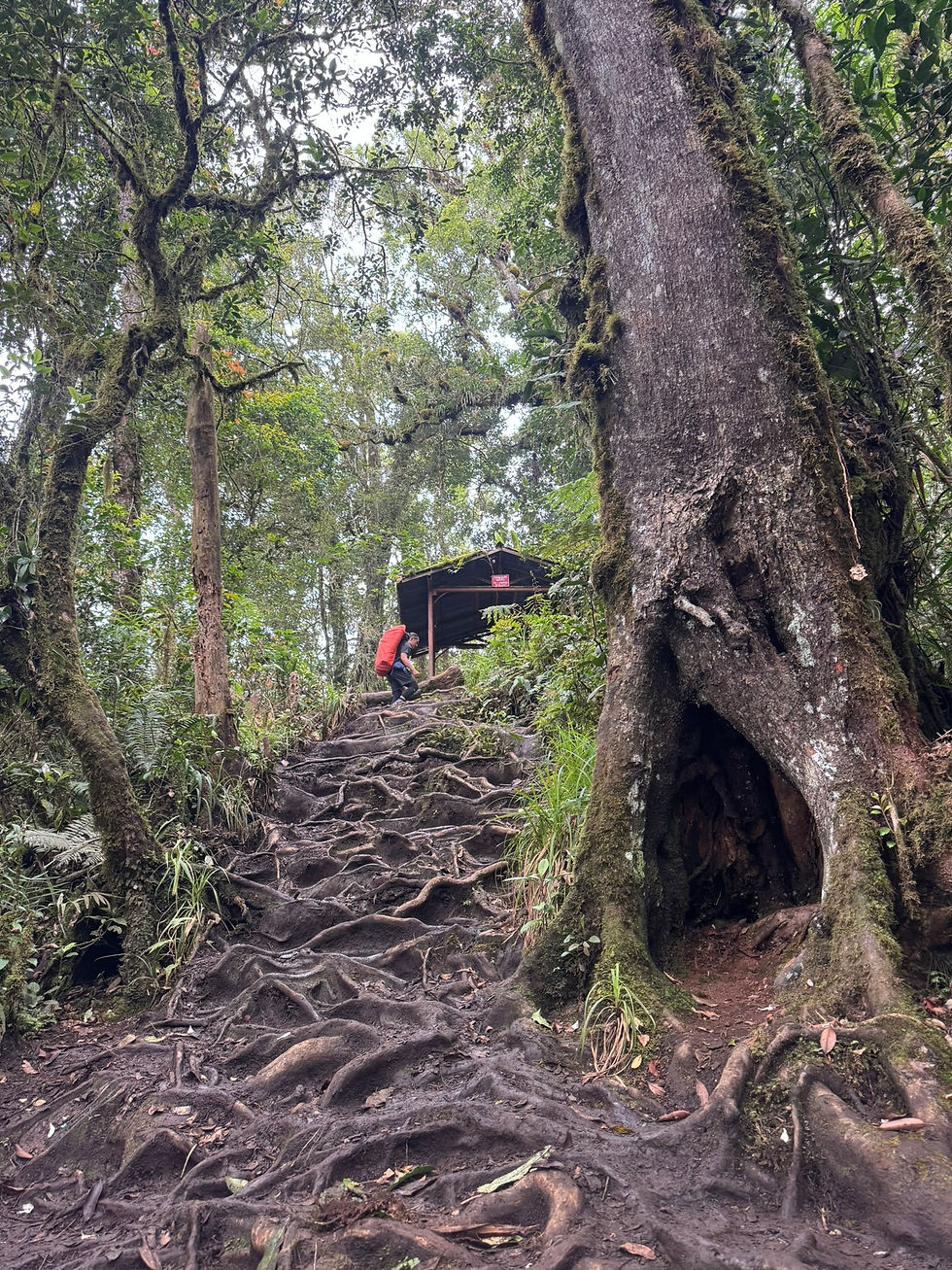
Another uphill slog through the tree roots brought me to Pos 3, where a big group of teenagers eyed me cautiously. When I smiled and waved, their hesitation melted away. All sixteen crowded around for a group photo, then recorded a video in Bahasa proudly announcing they had met me. To my surprise, they even wanted to dance to the famous Indian song Chaiyya Chaiyya a tune that had somehow traveled from Bollywood’s trains to Sumatra’s mountains.

A couple approached me with an offering of duku fruit. When they saw how much I enjoyed it, they generously handed me a whole handful. The small, round fruit was delicious — sweet and refreshing, with a flavor reminiscent of lychee, yet unlike anything I had ever tasted before.

The descent began on a narrow path tangled with slippery tree roots. Each step demanded focus, the ground slick and treacherous. Luckily, a rope ran alongside; wet and muddy, but supportive enough to steady my grip as I eased my way down.

Fog began to curl around the trees as I moved along, softening the forest into a dreamlike haze. The path ahead blurred, each step carrying me deeper into a mysterious world.

Soon the lake inside the caldera, Danau Gunung Tujuh, came into view. Calm and greenish, it lay shrouded in fog, its surface reflecting the misty silhouettes of the surrounding peaks. Hundreds of other hikers were scattered along the shore, all quietly soaking in the beauty of nature at this extraordinary mountain lake.

I longed to reach the spot where everyone was gathered, but a hundred meters of treacherous slope still stood between me and the lake. Each step down the slick, root‑laced path felt like a test of patience and balance, the laughter and chatter below pulling me onward.
Once at the lake, I filmed a full 360‑degree video of my surroundings — lush green mountains rising above, a waterfall tumbling at the entrance, ferns and giant rocks framing the shore, and smiling hikers scattered all around. It was a panorama of nature and humanity, woven together in one unforgettable scene.
The guide explained that being a weekend, hundreds more hikers would soon arrive to visit and camp by the lake. He suggested we camp farther away, though it meant a half‑hour ride in a hand‑oared boat. I agreed. As we waited for the boatman, the fog thickened, curling into a dense shroud, and then the rain came, supremely heavy, drumming on the lake and turning the world into a blur of water and mist.
Two hours later, the skies cleared and we set off in the boat. My guide asked if I liked fish, and when I answered with an emphatic yes, he promised we would catch some for dinner. I was puzzled at first, but soon the operation revealed itself. Scattered across the lake were thirty‑odd empty bottles, each bobbing gently on the surface. When pulled, a long string emerged, ending in a submerged fish trap. One by one, we hauled them up, each trap wriggling with sardine‑sized fish. After emptying three traps, we had enough for a hearty dinner, paired with tempeh, simple, fresh, and perfect after the long hike.
After a sound sleep, it was good to wake up and see the lake just outside the tent. The small canal beside me, its flowing water joining the lake, had been a soothing background sound through the night. Scattered clouds still revealed the caldera, ringed by the seven mountains, the very reason it is called Tujuh in Bahasa.
At 10 a.m., the boatman arrived, helped us pack, and ferried us back to the entrance. The round‑trip fee was IDR 200,000, about twelve dollars, a small price for the journey across the misty lake and the memories it carried with it.
On the way back, Kerinci’s peak revealed itself little by little, rising through the shifting clouds. I made a quiet mental note: one day, I would return to stand on its summit.
The return journey was every bit as difficult, steep uphill, roots slick with rain, and mud clinging to every step. The towering trees remained awe‑inspiring, and the cheerful faces of new hikers and their porters offered brief encouragement. Yet the downpour from the previous evening had made the trail treacherously slippery. I misjudged a step and fell, my wrist breaking the impact. My guide, ever attentive, offered water from his bottle so I could wash the mud from my hands. I pressed on, only to stumble again a few steps later, this time falling even more heavily.
As I navigated the jungle of tangled roots, I passed a towering tree of immense height. Its sheer majesty stopped me in my tracks, and I took a video to remind myself of its grandeur.
To keep my mind off the long descent, I listened to Rebecca Newberger Goldstein’s The Mattering Instinct. I had reached the part where she quoted physicist Sean Carroll: “Everything we are, everything we have, is on loan from the universe, and entropy is the lender who will eventually come to collect.”
The idea that the mattering instinct is our biological resistance to the Second Law of Thermodynamics struck me deeply. As I picked my way down the slippery roots, I couldn’t help but think: I hoped entropy would not collect my eye on an exposed root, nor my knee in a sudden tumble.
Entropy left me alone, and I returned to the starting point with all limbs and organs intact. I felt quietly triumphant, happy to have visited Tujuh even though Kerinci itself was closed, grateful for the chance encounters with smiling people, and deeply content in the embrace of nature.


Comments