Kathmandu, Lukla & EBC
Updated: May 2
For more than a decade, the idea of standing at Everest (aka Sagarmatha, Chomolungma) Base Camp (EBC) had been sitting quietly on my list, refusing to be forgotten. I missed my chance during my Nepal & Bhutan trip in 2020, and when I finally planned it again for October 2025, the universe intervened with a HAPE incident in Bolivia that forced me to postpone.
I rescheduled for April 2026, only to watch the plan unravel yet again when the Iran war disrupted air routes and cancelled my Nepal flights that transited through Kuwait. At that point, most people would have taken the hint, but I wasn’t ready to let this goal slip away. I bought an entirely new set of tickets, determined that this time, no geopolitical crisis or medical surprise would keep me from reaching EBC.

However, as you’ll see in the rest of this blog, the universe had other plans. By the end of it all, I was simply grateful to walk away with my life intact, goal unaccomplished, ego slightly dented, but alive to tell the story.
First things first: the gear check. For a 13‑day trek into thin air, the packing list becomes a small test, what do you truly need, and what weight are you willing to suffer for? I had my warm trekking pants, three types of shirts for the ever‑changing Himalayan moods, a reliable jacket, and sturdy shoes that had already survived a couple of adventures. Nepal Hiking Team, my tour operator, issued a heavy‑duty sleeping bag and an insulated expedition jacket, the kind that makes you feel like a walking duvet. A porter was assigned to carry about 13 kilos of my gear, a humbling reminder that someone else’s strength was literally supporting my dream.
Before departure, I wandered through Kathmandu’s maze of trekking shops to pick up the last few essentials: thick gloves, snow goggles, merino wool socks, alkaline batteries, and a small 10‑liter backpack for the summit‑day push.
On the streets of Thamel, it was impossible to miss the Everest crowd. Hundreds of trekkers streamed past in their foreign jackets, shiny new boots, and backpacks that still had that “fresh from REI” confidence. Every other storefront seemed to be selling climbing gear, and the sheer volume was almost comical, row after row of down jackets, crampons, trekking poles, and headlamps. You could find absolutely anything you needed, often at suspiciously low prices. The shopkeepers called them “first copies,” a euphemism that made me smile; they looked convincingly like the real thing, right down to the logos, but cost a fraction of what you’d pay back home.
You can’t be in Kathmandu and not eat momos, Before the trek began, I treated myself to a proper sit‑down momo feast: ten mutton momos and a plate of cheese momos that tasted far too good to be innocent. My blood sugar promptly rocketed to 350, a reminder that Himalayan cuisine doesn’t care about your medical plans. While I worked through the dumplings, I chatted with a French couple fresh off a 10‑day Annapurna circuit and a Lebanese–Spanish couple who had just finished a four‑day Pokhara trek. Everyone had their own version of “the mountains humbled me,” and it felt like a small preview of what awaited me.
Back at the hotel, I did the final weigh‑in: my backpack came in at 5 kg without water, and the porter bag at 13 kg, a number that felt both reasonable and ominous. I started on 125mg diamox twice a day to get easier acclimatization.
Before dawn the next morning, at 5:30 a.m., my guide arrived to take me to Kathmandu Airport for the flight to Lukla, the tiny airstrip where the real journey was supposed to begin.
All that early‑morning rushing turned out to be completely pointless. The weather had collapsed over Lukla, and flights were being reduced, delayed, or cancelled in batches. When our group of fifteen was finally cleared to board, we were overjoyed, practically vibrating with relief. A bus ferried us out to the active runway, where we waited for the Summit Air aircraft that was supposed to take us to the world’s most notorious airstrip. It eventually landed, and the sight of it right in front of us made everyone giddy with anticipation. And then… nothing. Two full hours of sitting in that bus, staring at the aircraft we were meant to be on, while the weather refused to cooperate. Eventually, an airport staff member climbed aboard and delivered the verdict: all flights were grounded. We were to return to our hotels and try again tomorrow. Everest, it seemed, was already testing my patience.
We trudged back to the hotel in defeat, but our tour operator wasn’t ready to give up. Within an hour, he had bundled four of us into an SUV and announced a new plan: we would drive to Ramechhap, the alternate airport for Lukla flights. What he didn’t mention was that the 125‑kilometer journey would take six hours and involve navigating flood‑ravaged riverbeds that barely qualified as roads.
The ride shook every bone in our bodies, a relentless pounding that made my earlier “African massages” feel like gentle warm‑ups. By the time we reached Ramechhap, we were bruised, dusty, and clinging to the hope that this detour would finally get us into the mountains.
The next morning, we were at Ramechhap airport by 5:30 a.m., bleary‑eyed but hopeful. Luck finally tilted in our favor, and by 10 a.m. we were boarding the tiny plane to Lukla. The 35‑minute flight threaded its way through the mountains, revealing a maze of zig‑zagging trails etched into the slopes below. Inside the cabin, though, the mood was less scenic appreciation and more collective anxiety. Turbulence tossed us around, wind shear alarms chimed, and the proximity‑to‑terrain warnings lit up like a Christmas display. Every sudden drop or sharp turn rattled the passengers, and honestly, even the bravest among us looked like we were reconsidering our life choices. It was the kind of flight that reminds you why Lukla is famous for all the wrong reasons.
Lukla is called the most dangerous airport in the world for good reason. The runway is barely 527 meters long, shorter than a football field, and tilts sharply uphill, ending abruptly at a stone wall. The other end drops straight into a deep valley. There are no go‑arounds, no second chances; once a pilot commits to landing, they must land. Add unpredictable mountain weather, sudden cloud cover, and fierce crosswinds funneling through narrow valleys, and every flight becomes a small act of controlled defiance against the Himalayas.
We landed safely, and the entire cabin exhaled in unison, a long, shaky, collective sigh of relief. For a moment, no one moved. We just sat there, grateful that the world’s most notorious runway had accepted us without drama. We had made it to Lukla, and the real adventure could finally begin.
The air already felt thinner, sharper; Lukla sits at around 9,300 feet, and my body wasted no time reminding me of it. Still, with warm tea in hand and the trail finally ahead of us, it felt like the real beginning.
After checking out the airport area and fully appreciating just how precariously that runway clings to the mountainside, we lingered long enough to watch another plane attempt its nerve‑wracking landing. Then we ducked into a nearby restaurant for a quick cup of tea before starting the trek.
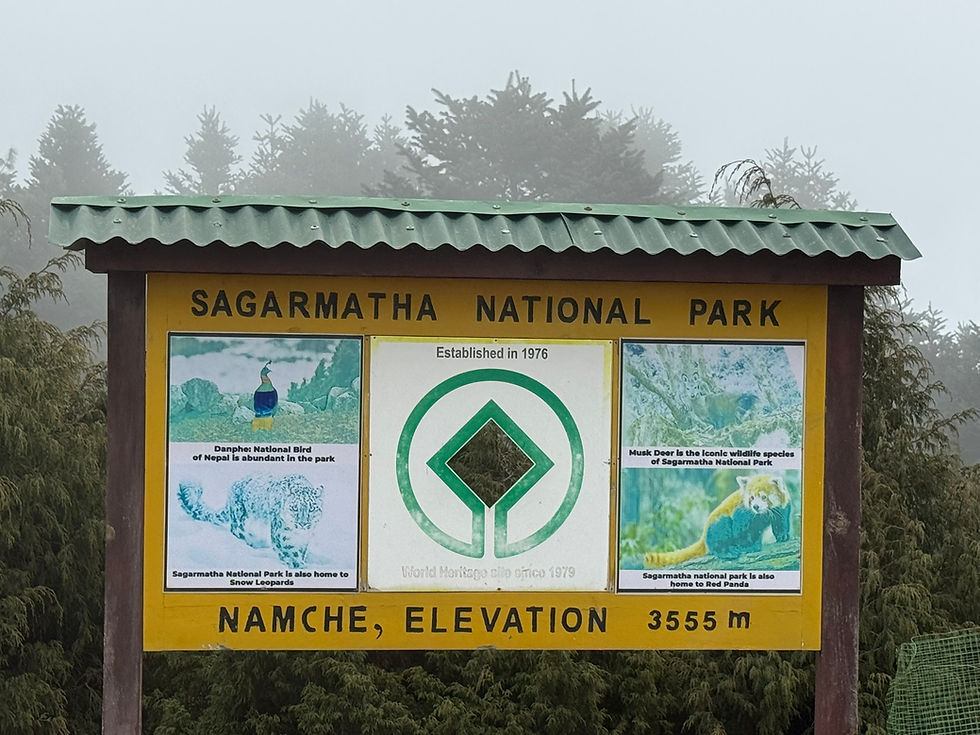
Since we had lost a day because of a missed flight, our guide suggested we push a little farther than the usual first‑day stop in Phakding and continue on to the next village, Monjo. It turned out to be a gentle extension, an extra hour or so of walking along the Dudh Kosi River and it actually worked in our favor. Reaching Monjo meant we were already inside Sagarmatha National Park and better positioned for the long climb to Namche the following morning, helping us make up the lost time without compromising acclimatization.
Essential Trekking Safety Guidelines, a big sign welcoming adventurers to the Khumbu region, reminded us that altitude sickness isn’t a myth here, oxygen thins fast, and caution is part of the journey. Reading it felt like the mountain’s first quiet warning before the trail even began.
Another signboard introduced the legacy of Sir Edmund Hillary, not just the man who first stood on Everest, but the one who built schools, hospitals, and entire communities in the Khumbu. Places like Khumjung Monastery, Khunde Hospital, and the Hillary School stood as quiet reminders that his greatest achievements were the ones that helped the Sherpa people thrive. It added a layer of meaning to the trek that went far beyond the mountains.
Every so often, we passed a rectangular mani wall or a slightly conical chorten, each carved or painted with characters from the Tibetan script. Our guide gently reminded us to always walk on the left side of these sacred structures, a small gesture of respect believed to bring blessings and good luck for the journey ahead.
We often found ourselves sharing the trail with long trains of yaks or mules, their bells echoing through the valley as we settled into the steady rhythm of walking at nearly 10,000 feet with our backpacks. Our porter was always far ahead, a small silhouette moving effortlessly up the path, while our guide stayed close, pointing out distant peaks and tiny villages tucked into the hillsides. He had a gentle, unhurried way about him, constantly checking in on me, offering water from my own backpack, handing me snacks before I even realized I needed them. It made the long stretches feel lighter.
Stupas and prayer wheels appeared along the trail like quiet companions, their colors bright against the landscape, while cherry blossoms drifted in the breeze and enormous beehives clung to the cliffs above us. The Dudh Kosi River roared beside us, a constant ribbon of white water cutting through the valley, and beyond it the vast mountain ranges rose and disappeared as we rounded each bend. All of it passed by in a kind of slow, peaceful rhythm as we continued our walk through the Himalayas, letting the scenery unfold one gentle moment at a time. We made our way over one of the many suspension bridges we would encounter on this trip.
The mule trains were frequent along this stretch of the trail. After our brief stop in Phakding for water, we continued walking and soon stepped aside again to let another long line of mules pass.
Despite the guide’s earlier reminder to always stay on the safe, mountain side of the path, I somehow ended up on the exposed left edge. The entire train went by without issue, until the very last mule, which carried two large milk crates jutting out from either side. I saw the crate swinging toward me and instinctively shifted just a few inches. What happened next felt like a scene unfolding in slow motion. I tumbled off the trail, rolling again and again, six times at least, down a steep cliff. The drop continued for hundreds of feet, but by some miracle my fall was broken after about fifty or sixty feet by a dense tangle of thorny bushes.
In the three seconds it took to fall, I collected a constellation of cuts and bruises, and above me I could hear my guide and others screaming my name. Once I stopped moving, I took a breath, called up to say I was safe, and watched in disbelief as two guides somehow descended the near-vertical slope to reach me. My backpack had slipped off, my water bottle was gone, and one of my headphones, along with its case, had vanished into the bushes.
Slowly, they gathered everything they could find and helped me climb back to the trail. Within minutes, four or five other guides from the same company arrived, all shaken but relieved that my injuries were minor. No concussion, no broken bones, no punctures, just torn clothing, scratches, and the loss of a headphone. Considering it was April 13th, everyone joked that the date hadn’t been unlucky for me after all. If anything, it felt like I’d been incredibly fortunate.
It felt like yet another reminder that this EBC trip was determined to defy me at every turn. Even after finally reaching Lukla, the mountain seemed to whisper its own warning: not so fast.
Phakding was my first real chance to breathe, a place to sit down, warm up, and quietly relive the day’s narrow escape from disaster. Over dinner, I shared a glass of Khukri Rum with the guides who had pulled me out of trouble earlier. The drink warmed our spirits, literally and figuratively, and for the first time since the trip began, I felt the heaviness lift.
A good meal, a pot of ginger tea, and a solid night’s sleep helped wash away the negativity, and by morning I felt ready to welcome the new day.
A little farther along the trail in the morning, we reached a suspension bridge that had recently been replaced by a newer one built much higher above the valley. As I crossed, the old bridge hung below like a relic from another era, swaying gently in the wind. Moments later, a long train of mules clattered across the new bridge, bells ringing, hooves thudding on metal grates, a sight so dramatic and so uniquely Himalayan that it stopped me in my tracks.
There was a short stretch where park rangers were repairing the trail, creating a small traffic jam of hikers loaded with oversized backpacks. I didn’t mind the pause at all, it gave my legs a chance to recover. My SpO₂ hovered in the low 90s, and I was feeling surprisingly good for the altitude.

The trail ahead climbed through steep sections, and somewhere along the way we came across a sight I won’t forget: a man hauling what must have been over 100 kilos on his back, supported only by a thin strap across his forehead. It was humbling, almost painful to watch. While I trekked for adventure, he carried that weight for a living, day after day, step after step.
Enroute, Jorsalle was the last quiet breath before the climb to Namche, a small riverside village tucked between suspension bridges and pine forests. It’s the place where trekkers fuel up, cross the final checkpoint, and step into the real ascent of the Khumbu.
The trek from Monjo to Namche Bazaar took about five hours, climbing roughly 997 meters with a modest 188‑meter descent along the way. Namche itself is a burst of energy after the quiet trail; a hillside amphitheater packed with life.

The narrow, sloping streets are lined with hundreds of shops, selling everything a hiker or wandering tourist could possibly crave, like massages, shoes, socks, toilet paper, helicopter rides to Base Camp, espressos, electronics, knockoff jackets, and every piece of trekking gear imaginable. It’s chaotic in the best way, and simply walking around feels like an event.

We reached Namche by midday, grabbed lunch and had some rest. Later, we set out for the Tenzing Norgay Heritage Site, a short but steep 400‑foot climb that doubled as our acclimatization hike for the day.


Inside the small museum at Namche, the walls are lined with reminders of what these mountains demand and what they inspire. A framed reflection from The Ascent of Everest speaks about teamwork and the shared thrill of chasing something bigger than oneself, a sentiment that feels especially real in the Khumbu. Nearby, a display of the fourteen 8,000‑meter peaks lays out the scale of the Himalaya and Karakoram, the “death zone” heights, the first ascents, the winter conquests, a quiet catalog of human ambition against impossible odds. And then there’s the exhibit on the changing role of Sherpas, tracing their journey from load‑carriers to route‑setters, guides, entrepreneurs, and world‑class mountaineers in their own right. Reading it all together, you feel the cost of every summit, and the deep interdependence that makes climbing in these mountains even possible.

Just above Namche, the trail passes a quiet memorial to Pemba Doma Sherpa, one of Nepal’s pioneering female mountaineers. Her bronze likeness stands framed by prayer flags and a white stupa, a reminder of both her remarkable achievements on Everest and Lhotse and the cost at which Himalayan dreams are sometimes pursued. It’s a peaceful spot that makes you pause, breathe, and feel the weight of the mountains’ history settle around you.
At Namche, I even found a pair of AirPods knockoffs, the kind that arrive from China looking almost indistinguishable from the real thing, for about $50. A tempting quick fix to replace the ones I lost in yesterday’s fall. In a place like Namche, you can replace almost anything except your dignity after a wipeout.
The next day was technically supposed to be our rest day, but we had already scrapped that from the itinerary. The usual plan is a short acclimatization hike to the Everest View Hotel and then back to Namche, but instead, we were pushing onward to Tengboche (3,860 m / 12,660 ft). We checked with our guide, half‑worried we might be skipping the only guaranteed Everest viewpoint, but he just smiled and assured us that the trail ahead offered plenty of Everest sightings from different angles. With that reassurance, we packed up and got ready for the trail from Namche to Tengboche.
The initial steps out of Namche Bazaar were brutal and knocked the wind out of us almost immediately. But as the trail settled into a rhythm, so did we, and soon we were climbing steadily toward the first small village, a welcome stop where we could grab a coffee and catch our breath. From here, the views opened up dramatically: Ama Dablam, elegant and unmistakable at 6,814 meters, dominated the skyline, while the summit of Everest teased us on and off as clouds drifted lazily across its face.
Coffee in hand, it felt like the perfect moment, right before the trail plunged into a long, punishing downhill that dropped us all the way to 10,850 feet, erasing in minutes the hard‑earned elevation gains of the past two days. A mentally distressing stretch, but all part of the Everest Base Camp dance.
In Tengboche, I stayed at Tashi Dhelek Lodge, a surprisingly comfortable stop at 3,860 meters, complete with an excellent solar shower, a luxury I didn’t expect at this altitude. The place was buzzing with trekkers from everywhere: Lithuania, Wales, Germany, England, Canada, the US, China, India, Myanmar, Russia… a truly international gathering under one wooden roof. My guide and I shared a quiet Johnny Walker Black to celebrate making it this far, while the adjoining bakery kept everyone happy with hot coffee and slices of banana bread. Power outlets and Wi‑Fi were free, another small miracle in the Khumbu.
The night was rough, I woke up several times, never quite settling into sleep. By 6 AM I finally gave up, got out of bed, and plugged in every device I owned. The cold bit hard that morning, so I pulled on my thick warm pants and headed down for breakfast: an omelet and a steaming cup of ginger tea.

We left Tengboche at 7:35 AM, bound for Pangboche, just 4 km away but feeling much farther in the wind and cold. My jacket and gloves earned their keep. I walked like a zombie on the flats and an even slower zombie on the uphills, while the men carrying 100‑kg loads on their backs moved past us like mountain spirits, absolute heroes of the Khumbu.
We stopped briefly at Sadhna Somare, a small village in the Solukhumbu district, where my guide endlessly patient pulled water out of my bag before I even asked. Small kindnesses matter a lot at altitude.

Dinner at the lodge felt like a mini‑United Nations, about thirty trekkers from every corner of the world. A girl aiming to summit Everest sat next to us, calm and focused, while a girl from Siberia kept complaining about how cold it was, which somehow made the rest of us feel better about our own shivering. It was a slow, easy dinner, but I could feel a mild headache and a wave of malaise settling in. By the time I checked my SpO₂, it was just 70.
I decided the only sensible plan was to sleep longer and hope my body caught up.
The night was rough. I woke up repeatedly, coughing, and somewhere around midnight a fever crept in. I took a Combiflam, sweated through it, and finally felt a bit better around 7 AM. My SpO₂ readings were still all over the place, 74 on the fingertip device, 88 on the watch, but at least I felt human again. High altitude has its own way of humbling you, one breath at a time.
Today’s plan was a short acclimatization hike of 258 meters up to the Three Flags viewpoint. In about half an hour, we had already climbed 85 meters, and from the first flag we could see Taboche rising sharply against the sky.

My headache was gone, the cough had eased, and I felt relatively functional, even though I was still walking painfully slow and stopping every hundred steps to catch my breath.
We reached 15,140 ft (4,588 m), took a long break, and then walked the 3,260 steps back down to the lodge.
The descent erased the day’s gain, 258 meters (846 ft), but that’s the whole point of acclimatization. By afternoon, the cough returned, and I chewed Strepsils hoping for a quieter night.

Around us, the mountains were reminding everyone of their limits. A Russian trekker, lips turning blue, had an SpO₂ of 45 and had to be airlifted out. An Indian solo hiker, carrying just 13 kg, was exhausted after day one and hired a porter; by day five he was returning on horseback. The Khumbu humbles everyone differently.
My own night was rough again, coughing nonstop, barely sleeping. By morning my SpO₂ had dropped to 66, and then 61. No appetite, no energy, just a heavy sense that my body was done negotiating. That’s when I called the insurance company and requested evacuation.
I walked to the Dingboche clinic, where the staff took down my full medical history and checked every detail with calm efficiency. They settled me onto a cot and started supplemental oxygen, which I stayed on for nearly four hours while we waited for the insurance company to approve the helicopter evacuation. It was a strange mix of relief and frustration, relief that I was finally breathing easier, and frustration that the trek I had worked so hard for was slipping away. All I could do was lie there, listen to the hiss of the oxygen, and wait for the mountains to decide the rest.
Around 1 PM, the helicopter finally arrived, thumping into the thin air above Dingboche like a lifeline. In 35 minutes flat, we were descending toward a small helipad that I assumed had to be Lukla, the logical place, the place with a hospital, the place where an ambulance would be waiting. So, when I asked where the ambulance was, the staff burst out laughing.
Only then did they explain that my insurance company had dropped me in Surkey, a tiny village below Lukla, presumably because it was cheaper than landing at the actual Lukla helipad. No hospital. No ambulance. Just a windswept landing pad and a few amused locals shaking their heads at my confusion. It was one of those moments where altitude, exhaustion, and bureaucracy collided, and all you could do was laugh along with them.
Surkey sat at 7,280 ft, and the moment I stepped out of the helicopter I could breathe easy. But that relief didn’t last long. The insurance company had absolutely no idea how to help me from there. Their suggestion delivered with complete seriousness was whether I could “find a pony and ride it up to Lukla,” which sits at 9,300 ft. In my untreated HAPE state, the idea felt surreal.

I spent the next three hours trying everything: asking for a pony, asking for another helicopter, asking for any way to get to Lukla or, ideally, Kathmandu. Nothing. No animals, no flights, no solutions. Just the daylight fading and the cold settling in.
Finally, as darkness crept in, I managed to rustle up two porters, one to carry my backpack and the other to take the 13‑kg duffel. And so, with painful steps we began the two‑hour uphill climb to Lukla. But there was no other choice. It was the only way out.
By around 7:30 PM, I finally reached Lukla and checked into the Ganesh Himal Lodge. The porters dropped my bags at the entrance, gave a quick nod, and disappeared into the night. I stepped back outside to look for the Lukla Hospital, and Google Maps confidently told me I was standing right in front of it, which was absurd, because there was absolutely nothing resembling a hospital in sight.
A couple of locals walked by, and when I asked, they told me the hospital was a 25‑minute walk away, along a dark forest path with cliffs dropping off the side. When they heard my whole story, the HAPE, the mis‑drop in Surkey, the climb up in the dark, they immediately insisted I stay put at Ganesh for the night.

The next morning, I told my tour operator in no uncertain terms that I needed to get to Kathmandu as soon as possible. To his credit, he moved fast. He managed to secure a helicopter by reallocating the refund from my canceled Lukla–Kathmandu flight, which had been part of the original tour, and then asked for an additional $100 to close the gap. Given the circumstances, it felt like an excellent deal. After everything that had happened — Surkey, the climb in the dark, the night of coughing, the promise of a direct heli out of Lukla felt like the first real piece of good news in days.
In Nepal, patience is a built‑in part of the process. Even though the helicopter ticket had already been purchased, I still ended up waiting three hours at the Lukla helipad before my turn finally came.
But once I stepped onto the helicopter, everything shifted. The flight was smooth, almost soothing, and the entire landscape unfolded beneath us like a moving tapestry, snow‑dusted ridges, tiny villages with their blue tin roofs, endless zig‑zagging switchbacks, dense forests spilling down the valleys, and eventually the slow spread of urban Kathmandu appearing on the horizon. After the chaos, the coughing, the uncertainty, it felt like the mountains were giving me one last, unforgettable view before letting me go.
The insurance company instructed me to head straight to HAM Hospital in Kathmandu for a quick post‑evacuation checkup, just to make sure there was no lasting damage. I felt surprisingly good by then, so I assumed it would be an in‑and‑out visit, a formality. I took a taxi across the city, walked into the ER, and went through the usual round of tests: chest X‑ray, lungs, kidneys, vitals. Everything looked normal, and I was minutes away from being discharged when the doctor returned with a different tone. They had detected a lung infection and early pneumonia. Just like that, I was admitted.
The next two days were a blur of hospital routines, IV lines, saline drips, antibiotics, blood draws, nurses checking vitals every few hours. I felt trapped, restless, and frustrated, especially after everything I had already been through. But somewhere beneath that irritation was a quiet understanding: this was necessary. This was the price of what the mountain had done to my body. And this was the step that would finally set things right.
At long last, I was discharged from the hospital and free to breathe Kathmandu air without tubes, needles, or nurses waking me every few hours.
Almost at the same moment, my friend returned to the city after successfully completing the trek, and the timing felt poetic. One of us had reached Base Camp; the other had been rescued off the mountain. Now we slipped back into the rhythm of travelers rather than patients or trekkers.
Our first stop was Pashupatinath, a UNESCO World Heritage Site and one of the oldest and most sacred Hindu temples in Nepal, parts of it date back well over a thousand years. The temple complex sits along the Bagmati River, where cremations take place daily, an unbroken ritual of life, death, and release.
After everything I had just been through, standing there watching the smoke rise felt strangely grounding. It was a reminder that journeys don’t always go the way we plan, but they still take us exactly where we need to be.
Basantpur Durbar Square was our next stop, and it felt like stepping into a living museum. The intricately carved wooden windows — each one a masterpiece of Newar craftsmanship, were a sight to behold.

Stone guardian lions flanked the entrances to old palaces, frozen in mid‑roar as they had been for centuries. We climbed up the nine‑story Basantapur Tower, part of the old royal complex, and the views from the top were enchanting: a maze of red‑brick courtyards, temple roofs layered like pagodas, and the hum of Kathmandu life unfolding below us.
After days of thin air and mountain silence, the square’s energy felt warm and grounding, a reminder that Nepal’s beauty isn’t only in its peaks but also in its history, art, and the stories carved into every beam and stone.
After one last round of momos and a slow wander through the lively streets of Thamel, it was finally time to say goodbye to Nepal.
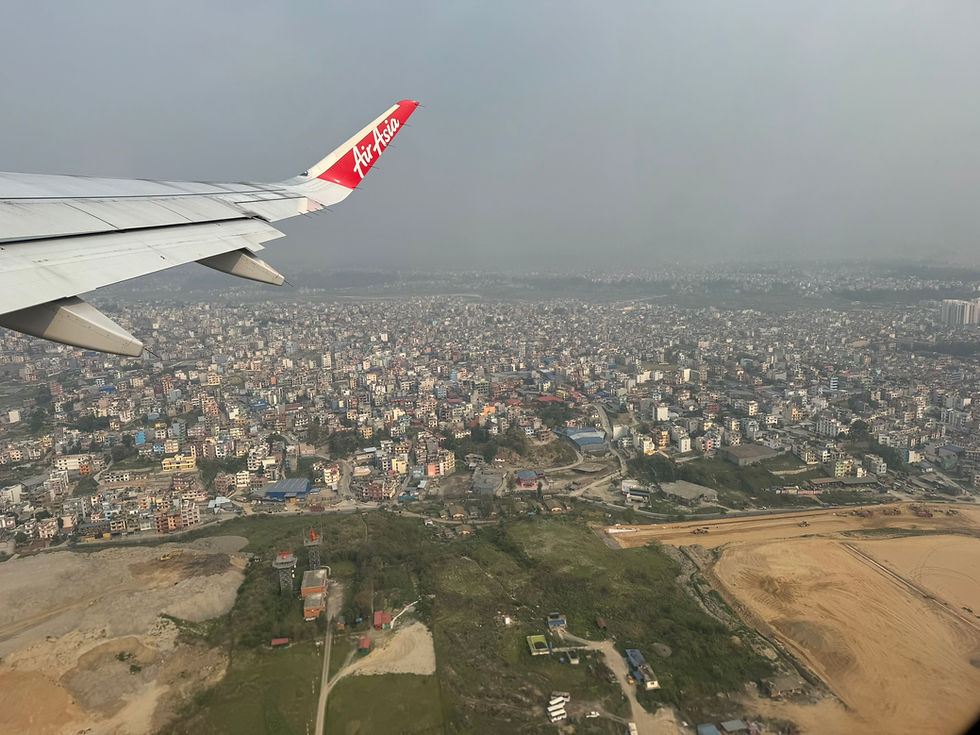
As the plane lifted off, the dense patchwork of Kathmandu’s homes spread out beneath me, tightly packed rooftops, winding alleys, and the soft haze of a city that had held both the hardest and most beautiful days of my journey. Watching it shrink below the clouds, I felt a mix of gratitude, exhaustion, and a quiet promise to return someday, when the mountains call again.
In the end, my goal of reaching Everest Base Camp remained unfulfilled, but the mountains gave me something far more personal. I learned what it means to triumph over fear, to confront the limits of my own physical stamina, and to accept them with humility rather than disappointment.
I came away with a deeper admiration for nature in all its beauty and brutality, and for the incredible porters who carry impossible loads with quiet strength. I learned that enjoying the journey is everything, that taking breaks is not weakness, and rushing is never worth the cost. I cherished every sunny day on the trail, right up until imminent HAPE at 4,410 meters in Dingboche on Day 5 forced me to turn back. The mountain stopped me this time, but it also taught me how to listen, how to respect its power, and how to return stronger.


Another great story from Hemant, one he was very close to not telling.
Sounds like a great adventure and Hemant uses up another one of his 9 lives
This is a beautifullly written blog, Hemant. I can’t wait until I have time to go back and watch the videos. Glad you are safe and back home.