West Highland Way & Edinburgh
In my multiple visits to Scotland, I had always been drawn to its endless greenery, the rolling hills, the moss‑softened trails, and its lochs. So, when I came across an article about the West Highland Way, the idea of walking it lodged itself firmly in my mind. It felt like the perfect way to immerse myself in the landscape rather than just admire it from a train or car window.
I convinced a friend to join me, and we planned to meet in Edinburgh on April 1, giving ourselves six days to walk as much of the trail as we could. We also set aside a couple of days for other pursuits, a visit to Inverness, perhaps a whisky distillery or two, because Scotland always rewards a little wandering.

I had flown Ryanair from Porto to Edinburgh, checking in my backpack without a second thought. By the time we landed, it was 1:30 a.m., a dead hour. One by one, every passenger collected their luggage and drifted out into the night… except me. My backpack never appeared. Soon the carousel stopped, the hall emptied, and I was standing alone in a silent airport.
With no staff in sight, I walked over to the immigration officer, who kindly tried to help but couldn’t locate the bag either. He eventually told me I had to exit baggage claim and file a report with the airline. Outside, I found the tiny Swissport office that handles Ryanair luggage. The lone employee inside looked up and informed me, without the slightest apology, that I would need to wait five hours before I could file a complaint or tell them to bring my bag to a hotel. I explained I was going to walk the trail and had no fixed location.
That’s when I remembered the Apple AirTag in my backpack. I opened the app, and there it was, my bag sitting about 200 feet away, tucked inside some back room where Swissport staff had simply forgotten to bring it out. Yet there was nothing I could do; no one was willing to retrieve it. I sat down on a chair in a cafe and dozed off, waiting for morning to come.
At 7 a.m., the Swissport staff finally arrived. I approached them, explained the situation, and, in a display of efficiency that made the night’s ordeal feel almost comical, they retrieved my backpack in seven seconds. Relieved, I walked out to the Airlink bus stop for the hour‑long ride into Edinburgh. It was a beautiful morning, the bus rolled past stone houses, church spires, and the first hints of the Old Town skyline. Soon enough, I was in the heart of Edinburgh.

The Scott Monument, rising in dark Gothic spires above Princes Street, caught my eye. I read that it was built in 1846 to honor Sir Walter Scott, the beloved author of the Waverley Novels. A small plaque at its base quietly explains it as a city’s tribute to the writer who shaped so much of Scotland’s literary identity.
Walking through Edinburgh that morning, I found myself admiring the city’s old, ornate Victorian and Gothic architecture. Eventually I wandered into Brewhemia, a lively, multi‑floor café‑bar just across from Waverley Station. It was the perfect place to settle in for a leisurely breakfast while waiting for my friend, who was flying from San Francisco to London and then catching a train up to Edinburgh.

He arrived by 2pm and together we headed into Waverley Station to begin our multi‑hop journey to Milngavie, the official starting point of the West Highland Way.
It was interesting to learn that Milngavie is pronounced “Mull‑guy”, a surprise to anyone seeing the spelling for the first time. When we arrived, it was around 5 p.m. and raining steadily.

We were supposed to walk the first 12 km to Drymen, a prospect that felt increasingly unrealistic given the weather and the early April darkness closing in. After a brief, silent exchange of looks, we abandoned the idea of starting the West Highland Way in a downpour and hopped into a taxi to Drymen instead.

Even though we felt we hadn’t quite earned it, having skipped the rainy first stretch, we still made our way to The Clachan, the oldest licensed pub on the West Highland Way, dating back to 1734. Inside, the low ceilings, stone walls, and warm glow of the lamps made it feel like stepping into a living piece of Scottish history. We enjoyed a fantastic dinner while watching the locals unwind over cocktails and hearty meals.

Early the next morning, after a hearty full Scottish breakfast at the Drymen Inn, we set off on the West Highland Way. The day’s walk was roughly 24 km, a long but beautiful stretch that would eventually lead us to the Rowardennan Hotel on the shores of Loch Lomond. The air was cool, the trail soft underfoot, and for the first time on the trip, it felt like the real journey had begun.
Walking through meadows and pastures, past streams and old dry‑stone walls with their perfectly stacked, pointed stones, we continued inching our way along the trail. Some sections of woodland had that Lord‑of‑the‑Rings‑like atmosphere, twisted branches, moss‑covered trunks, the forest that felt ancient and enchanted. Gradually, we climbed toward Conic Hill, the day’s big landmark, its ridge offering the first dramatic views of Loch Lomond and the Highland boundary ahead.

After the long climb up Conic Hill, the descent wound gently into a park area with cafés and picnic tables. We grabbed a quick lunch before starting the trail that hugs the eastern shore of Loch Lomond.
Near the waterfront stood a small outdoor display dedicated to Tom Weir, Scotland’s beloved “mountain man.” The board described his life as a writer, explorer, and broadcaster, a man who spent decades inspiring people to discover the Highlands. One quote of his captured the mood perfectly: how the light dances across the peaks and how the landscape reveals itself in shifting shadows.

The lone tree’s silhouette against the shimmering surface of Loch Lomond was too captivating to ignore. I stopped for a long, quiet moment, admiring the stillness of the water, the hills, and the sailboat.

Soon after leaving the lakeshore, the path unexpectedly tilted upward, turning into a steep climb that forced us to slow down. We huffed and puffed our way through it.
The views along Loch Lomond were simply splendid. The water gleamed silver, trees swayed, the rocks and pebbles along the edge formed quiet little patterns. Moss‑covered roofs peeked out from between the hills, and meadows opened up in soft green stretches. Everything together, the light, the textures, the stillness, added to the serenity of the scene.
The trail wound through stretches of birch and oak forest. Eventually we reached Cashel, a small woodland and campsite area along the loch, a natural pause point before the final push of the day. From there, the path continued to rise and fall until we finally reached our night’s destination: the Rowardennan Hotel.

The Rowardennan Hotel is a 300‑year‑old inn with comfortable rooms and one unforgettable quirk, a staircase so narrow, barely 18 inches wide, that carrying a backpack up it felt like a mountaineering exercise of its own.
The next morning, after a hearty Scottish breakfast of haggis, grilled tomatoes, black pudding, link sausages, eggs, and enough toast to fuel a small expedition, we stepped out into a wet, grey world. The path was already slick, and the forecast promised a day of steady rain. Our target was The Drovers Inn, about 14 km away.

Moss, ferns, and waterfalls stayed with us all day, along with gnarly tree branches that twisted overhead like something out of a fantasy novel. Somewhere along the wetter, rockier stretch, we struck up a conversation with Amy and her dad Alistair, both from the UK. She told us about her work as a solicitor, not a barrister, as we learned, and we traded stories about the quirks of work life in the US versus the UK. The miles passed more easily with good company, the kind of trail conversation that drifts between careers, travel, and the shared experience of choosing to walk long distances in the rain.

A little farther along, we passed an information board for the Great Trossachs Path, a route that threads through ancient woodlands and links the lochs and hills of this region. The map showed how these trails weave together, the West Highland Way, Loch Katrine paths, old military roads, all part of a landscape shaped for wandering.


We were happily surprised by how many waterfalls we encountered that day, some thin and ribbon‑like, others tumbling over mossy rock shelves, all feeding Loch Lomond below. Everything was green, a full‑saturation kind of green that felt like a reward for walking in the rain. Between the steady conversation and the steady drizzle, I kept stopping for photos and videos, unable to resist capturing every new cascade and twist of the trail.
The terrain shifted into a wilder, more rugged character as we moved along the loch. The path cut through a mix of sodden grass, bracken, and heather, with patches of moss‑covered ground that glowed even under the grey sky.
Leafless trees stood like silhouettes against the water, their branches twisted by years of wind and weather. On one side, the hillside rose steeply in browns and greens; on the other, Loch Lomond stretched out in a soft mist. It was a moody, quiet landscape, raw, beautiful, and unmistakably Highland.

The path kept changing character, sometimes waterlogged and squelchy, sometimes forcing us up or down short ladders bolted into the rock to navigate the steeper sections. More waterfalls appeared around every bend, each one feeding the loch and adding to the soundtrack of the day.
Somewhere along this rugged stretch, I chatted briefly with a Brazilian solo hiker, a big, tall guy with a flowing beard that made him look straight out of a Viking saga. He was carrying a 30‑kg (66 pounds) backpack and camping deep in the forest each night, a level of commitment that made our wet day hike feel almost luxurious.

This spot was a well‑known vista point, marked by the ruins of an old stone cabin overlooking the loch. The weathered walls and lone chimney gave it a timeless character, a reminder of the people who once lived and worked in these remote Highlands. Framed by the hills and water, it felt like stepping briefly into another century.

A little farther on, the trail opened up to a clear viewpoint marked by the Ardlui – A Window on the Loch sign. It explained how walkers could cross the water by ferry, simply hoisting a ball to signal the boat from Ardleish, a wonderfully old‑school system that felt perfectly at home in this landscape.

At long last, I reached the Inverarnan Drovers Inn, a sturdy old beast of a building, more than 300 years in age, with its original wooden floors still creaking under every step. After checking in and peeling off my soaked hiking shoes, I wandered barefoot into the lounge, only to discover that those same original floors came with original nails poking out of them, forcing me into an awkward tiptoe dance around the room.

My spirits lifted instantly, though, when I spotted the local spirit: multiple Loch Lomond Scotches, to be enjoyed just a stone’s throw from the loch itself. A fitting end to a long, wet, unforgettable day.
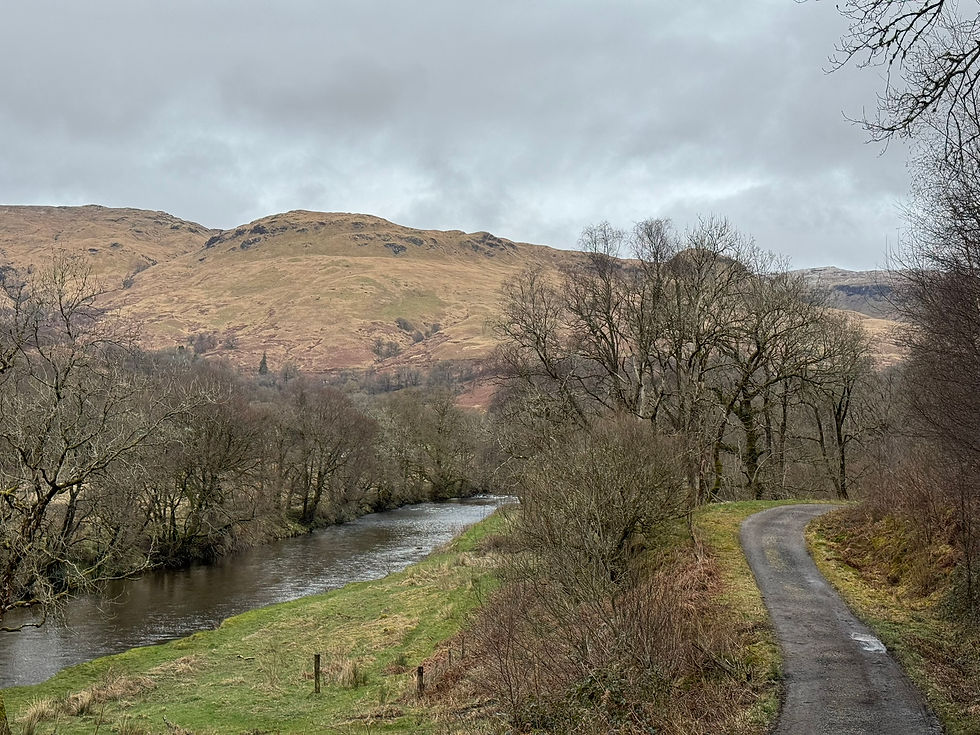
The next morning, our plan to repeat the Scottish‑breakfast routine hit an unexpected snag. With more than thirty walkers staying at the inn, everyone seemed to have placed their orders at 7 a.m., overwhelming the already stretched staff. My own order wasn’t taken until 8, and by then I was restless, anxious to get moving, and thoroughly tired of waiting. When the food finally arrived, I wolfed it down and we were back on the trail by 8:30.

A kilometer later, my friend suddenly announced that he’d left his iPhone in the toilet. Knowing he was already battling blisters, I told him to keep going while I turned around to retrieve it, a small detour in the grand scheme of the day, but one that felt very on‑brand for long‑distance hiking.

I retrieved the phone and headed back along the same stretch where I’d parted ways with my friend. I kept moving, hoping our paths would cross again at some point during the day.

A coule of hours later, I reached the Crianlarich crossroads, marked by a stone‑framed information board standing against a backdrop of distant snow‑dusted peaks. This spot marks the halfway point of the West Highland Way, where the high moorland of Glen Falloch meets the gentler passes of Strathfillan.
A little farther along, I came across one of the Highlands’ most iconic residents, the shaggy Highland cows standing calmly in a muddy field, their long coats swaying in the breeze and curved horns giving them a regal, ancient look.

It was 4 p.m., and I still hadn’t seen my friend. I reached the Glamping Hut at the "By The Way" Campsite in Tyndrum just as the weather unraveled into a chaotic mix of snow flurries, hail, and finally a wet, dripping snowstorm.
Then, at last, a cryptic text arrived: he’d gotten lost but expected to reach Tyndrum in a couple of hours. I checked in and collapsed onto the bed for a nap. I was exhausted, but more than that, I was freezing.
I woke up when my friend finally stepped into the hut, cold, tired, but safely back on track. We headed to the nearby Indian restaurant for some much‑needed hearty food.
And then, in true Scottish fashion, the sky suddenly cleared and the sun burst through, perfectly reinforcing the old saying that you can experience all four seasons in a single day. After the hail, snow, and soaking cold, the sunshine felt almost theatrical.

The next morning, we had a solid breakfast at the Real Food Café, just a short walk from the glamping hut, since the campsite itself didn’t serve any.

At the Real Food Café, we also ran into Amy and Alistair, who were just finishing up their breakfast. We exchanged contact info and caught up on the past two days of walking, the weather, the climbs, the small victories, the small miseries.
They were planning to push all the way to Kingshouse, a long 30‑plus‑kilometre haul, while we were in the same quandary as many WHW walkers: no accommodation booked, with the Inveroran Inn completely full.
We settled on a plan, walk as far as Bridge of Orchy, then hop on a train back to Tyndrum and stay at a local hotel.
Today’s walk was a study in contrasts, muddy and waterlogged underfoot, wet when the rain swept through, and damp even in the brief pauses between showers. Moisture hung in the air like a veil, and every so often the mist would lift just enough to reveal snow‑clad mountains in the distance, a reminder that Scotland has over 280 Munros scattered across its rugged spine.
By the time we finally reached the warm Bridge of Orchy Hotel, we were grateful for the shelter and the simple comfort of soup and sandwiches. After lunch, we wandered over to the tiny train station and caught the ScotRail service back to Tyndrum, letting the train cover in minutes what had taken us hours on foot.

The next morning felt like déjà vu, another hearty breakfast at the Real Food Café, another quick hop on ScotRail back to Bridge of Orchy, and then boots back on the trail.
With the sun trying to break through the clouds and the day still young, we picked up the West Highland Way right where we’d left off, ready for the long, open stretch toward Kingshouse Hotel.

It was a harder walk today, the views, though, never let up. All day long the mountains rose around us, their slopes streaked and capped with fresh snow, glowing whenever the light broke through the clouds. It felt wild, remote, and unmistakably Highland.
We passed by Inveroran and finally saw the inn we’d tried to book. We stopped at the little shop nearby, browsed the souvenirs, and picked up a couple of commemorative patches.
Nearly at 3 p.m., the Kingshouse finally appeared in the distance. My friend had fallen into conversation with a French solo hiker somewhere behind me, so I’d drifted ahead, settling into my own pace.
But the moment the hotel came into sight, I picked up speed, then picked up even more, driven by the irresistible promise of warmth, shelter, and a dry interior after a long, cold day on the moor.


I’d heard plenty about the resident red deer at Kingshouse, so it was a treat to finally see them up close. With their long antlers, shaggy manes, and those distinct, almost delicate hooves, they looked impossibly majestic against the backdrop of the Highlands.
Even though I’m usually exasperated by deer back home, forever nibbling on flowers and foliage they shouldn’t, these ones felt different.

It was time to celebrate, a proper dinner and a well‑earned whisky to mark the end of our walking trip. Reaching Kingshouse felt like a natural finish line for us. We weren’t planning to continue on to Fort William; my friend had a flight to catch in a couple of days, and we both liked the idea of slowing down, exploring a distillery or two, and letting the Highlands shift from effort to enjoyment. After days of mud, snow, wind, and long miles, raising a glass in the warmth of the hotel felt like the perfect way to close this chapter.
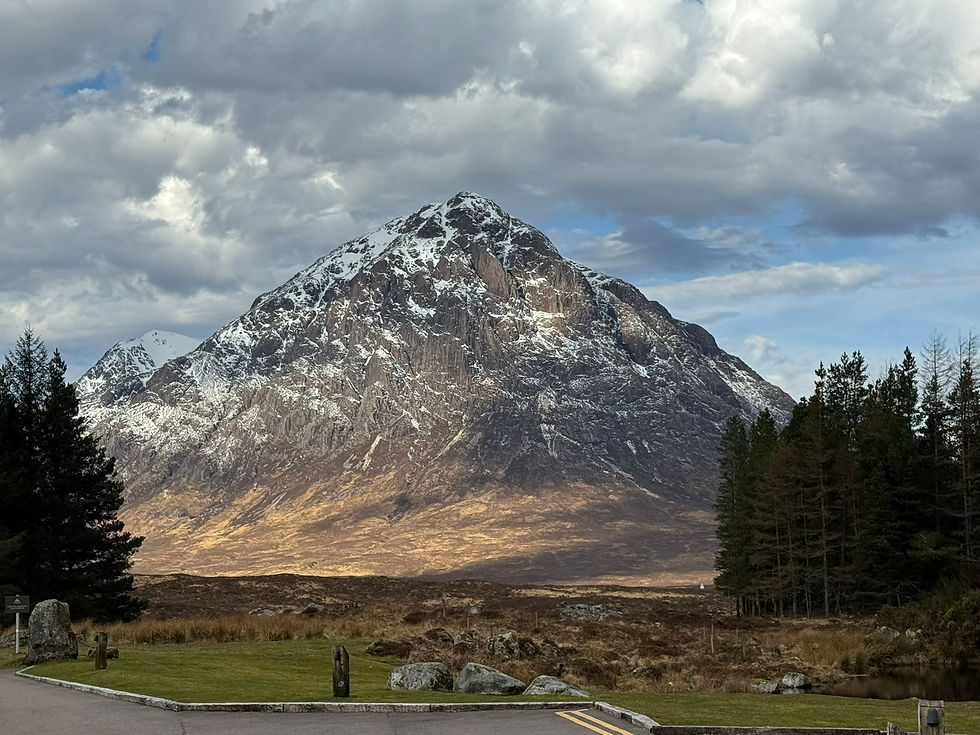
We booked an Ember bus for 8 a.m. the next morning, a comfortable, no‑nonsense ride that would take us straight to Edinburgh, where the Glasshouse Hotel, all sleek lines and modern luxury, was waiting for us.
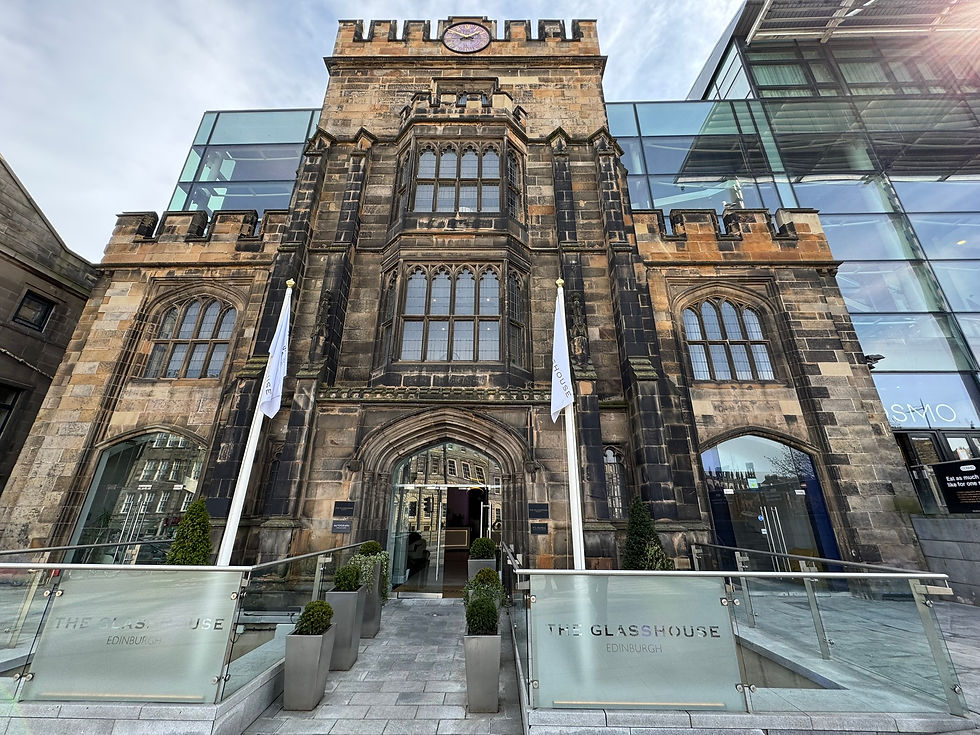
John, the usher at the Glasshouse, dressed smartly in his kilt, welcomed us with a warm smile and gave us a full tour of the hotel, including its impressive whisky collection of over a hundred bottles lined up like jewels behind glass. From our room, we had a clear view of Calton Hill, its monuments rising above the city like a stone crown. Even better, the hotel’s unique third‑floor rooftop garden opened directly onto a quiet patch of forest, a surreal pocket of greenery in the middle of Edinburgh. As a final touch, we were handed four whisky coupons, an invitation to sample the very collection John had proudly shown us.
After a late lunch at Dishoom, the Michelin‑recommended Indian restaurant from London that had opened its fifth location in Edinburgh, right next door to Gordon Ramsay’s place, we set out to explore the city on foot.

We loved the grand parade of architecture and history at every turn, wandered past soaring Gothic spires that pierced the sky, elegant neoclassical buildings crowned with sculpted pediments and regal figures frozen in stone.
The ornate Celtic crosses tucked behind iron fences or the imposing gates of the old divinity school marked with its 1846 crest, together made the city feel like an open‑air museum.
We stepped into the whiskey museum to admire the displays, one bottle stopped us in our tracks, a 50‑year‑old single malt, its price tag, a staggering £20,000, felt almost unreal. It felt like a fitting symbol of Scotland’s deep reverence for whisky, a reminder that in this country, time itself becomes an ingredient.

Meandering around these parts of Edinburgh felt like walking through a living postcard. We drifted through the green slopes of Princes Street Gardens, where people lounged on the grass beneath the shadow of the Scott Monument and the clock tower rising above the skyline.
A short wander brought us face‑to‑face with the dramatic silhouette of Edinburgh Castle perched on its volcanic rock. Nearby, modern storefronts and giant advertisements brushed up against Gothic spires, creating that uniquely Edinburgh blend of old and new.
Even the quieter corners held their own grandeur, neoclassical buildings with tall columns, elegant pediments, and sweeping lawns that made the city feel both historic and effortlessly alive. It was the perfect place to stroll without a plan, letting the architecture guide us from one story to the next.
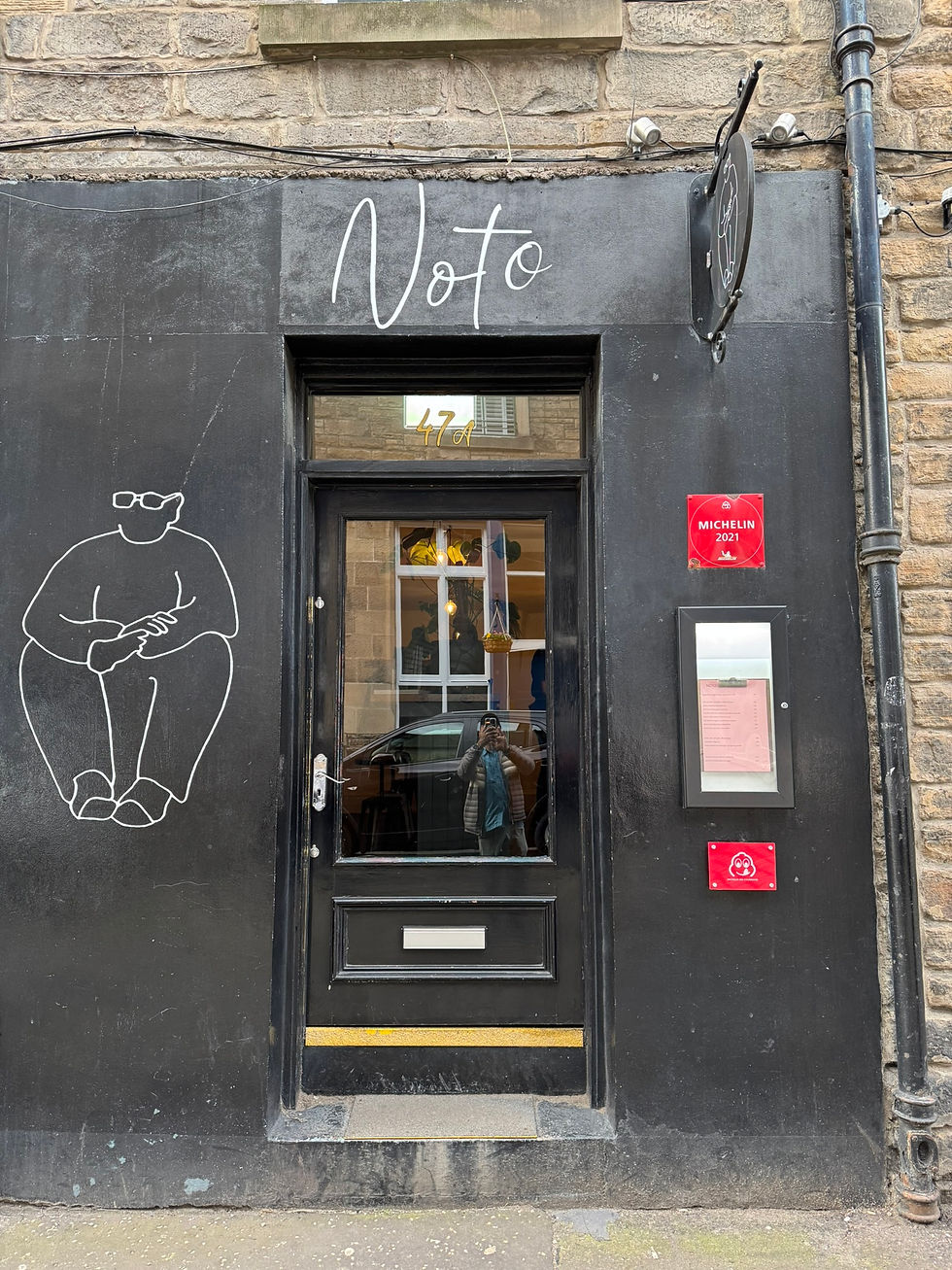
Our dinner was at Noto, a Bib Gourmand restaurant known for its inventive small plates inspired by Asian flavors. The dishes came out one by one, bright, playful, and beautifully balanced. It felt like the perfect culinary full‑stop to our Scotland journey.
We headed to the airport, its distinctive hourglass‑shaped control tower rising above the car parks like a piece of modern sculpture. After picking up our rental car, we drove north and soon found ourselves crossing the iconic Queensferry Crossing, its white cables fanning out in perfect symmetry against the grey sky.

The road carried us out of the city and into rolling countryside on our way to the Glenturret Distillery, often celebrated as Scotland’s oldest working distillery.

The Glenturret visit felt like stepping into the living heart of Scotland’s whisky heritage. Inside the old stone buildings, we learned how everything here is still done “by hand and heart,” just as it has been since the 1700s.
The mash house draws its water from nearby Loch Turret, only a few miles away, and every two weeks they bring in 26 tons of barley to create roughly 24,000 liters of mash in their traditional wooden washbacks. We saw the century‑old Proteus grinder, one of only a hundred in the world, still faithfully turning out perfectly milled grain. Lee, the machinist who keeps these antique parts alive, is practically a legend; he machines replacements by hand, and his work supports rare grinders scattered everywhere from Scotland to India to Tokyo to Australia. Even the staff felt like characters from a storybook, for example, John, who recently had a hip replacement yet still cycles to work to give distillery tours. Their pride in the craft was unmistakable.
The tour blended history, humor, and a touch of eccentricity. We heard about the distillery cat, famous enough to attract a Guinness World Records official who once counted the tails of the mice it caught every day for a month, and learned that despite the myths, the cat does not eat rat tails.

John talked of Fiona, who is still in training under master distiller Bob’s watchful eye to take over his job. John explained how yeast, peat, and water come together to create the spirit’s character, and how four days of fermentation build the sweet esters that define Glenturret’s style.

Stainless‑steel equipment gleamed beside old wooden vessels, a reminder that even the oldest working distillery in Scotland evolves with time. And tucked within the grounds is a two‑Michelin‑star restaurant and a handful of guest rooms, making it possible to stay right where the magic happens. It was a visit that blended craftsmanship, tradition, and personality — the kind of place where every machine, every person, and even the resident cat has a story worth telling.

Lalique, with its unmistakable crystal artistry, had crafted the stunning decanters for Glenturret’s rarest expressions, pieces that looked more like sculptures than bottles, glowing softly in their display cases.
After the tour, we joined the whisky‑tasting session, a lineup of drams that everyone else sipped thoughtfully while I simply listened, inhaled, and took careful notes.
With a rental car waiting outside, drinking wasn’t an option, so I collected my pours in small disposable bottles to enjoy later, somewhere far from the responsibility of Scottish roads. It was a slightly comical contrast, the elegance of Lalique glassware on one side of the room and my humble little containers on the other, but it didn’t matter. The spirit, the stories, and the craftsmanship were what stayed with me.
The next few hours on the road carried us steadily north, the landscape opening wider with every mile until Inverness appeared just as the sun began painting the sky in a cascade of colors, gold, rose, lavender, and the last deep blues of the Highlands.
It felt like the trip was giving us one final gift. We wandered into a fantastic seafood restaurant by the river for a long, lingering dinner. As the river darkened and the lights along the banks flickered on, it struck me that there couldn’t have been a more fitting capstone to the journey.


It always rains in Scotland - but the rain never distracts from the beauty of the Country.
Beautifully worded Hemant.