Cape Town: Trails, Wildlife & Ocean
Updated: Jun 18

I first became aware of Cape Town not through glossy travel brochures, but through headlines about its looming water crisis. In 2018 the city came perilously close to “Day Zero”, the moment when taps would run dry and residents would have to queue for water rations. Through strict conservation measures, innovative water management, and collective effort by its citizens, Cape Town narrowly avoided disaster. That resilience lodged the city firmly in my consciousness.
Although I had already explored Johannesburg, Durban, Kruger, and other corners of South Africa, Cape Town remained conspicuously absent from my map. Recently, I finally had the chance to spend a few days there to see for myself the city that had stared down drought, and to discover how its natural beauty and cultural vibrancy live alongside that hard‑won reputation for endurance.
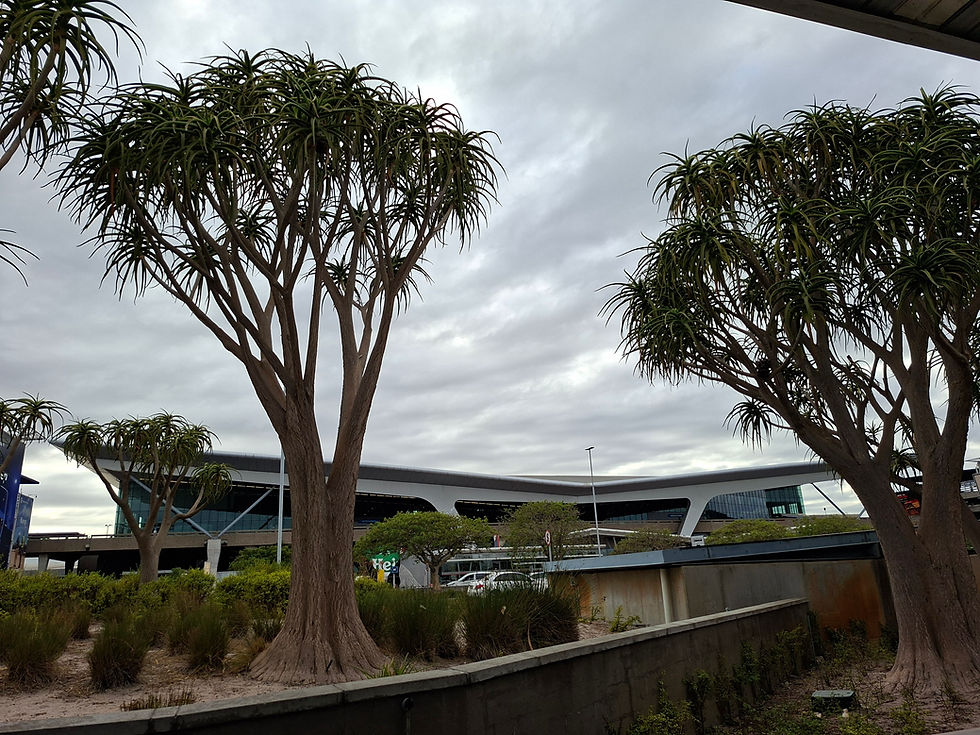
At the airport, while arranging the rental car, I noticed the striking quiver trees (Aloe dichotoma) standing against the modern glass backdrop. With thick trunks and spiky crowns, they looked almost prehistoric. Native to southern Africa’s arid zones, especially the Northern Cape, they’re often planted ornamentally around Cape Town. The San people once hollowed their branches into arrow quivers.

Checking into the Cape Town Hyatt, my friend, far more energetic than me, immediately proposed we hike up Table Mountain. We drove to the trailhead on that bright, sunny day, joining the throngs gathered at the base. The parking lot buzzed with thousands of visitors, most queuing for the cable car that whisks people to the summit in just a few minutes. We, however, searched out the trailhead, determined to tackle the mountain on foot.

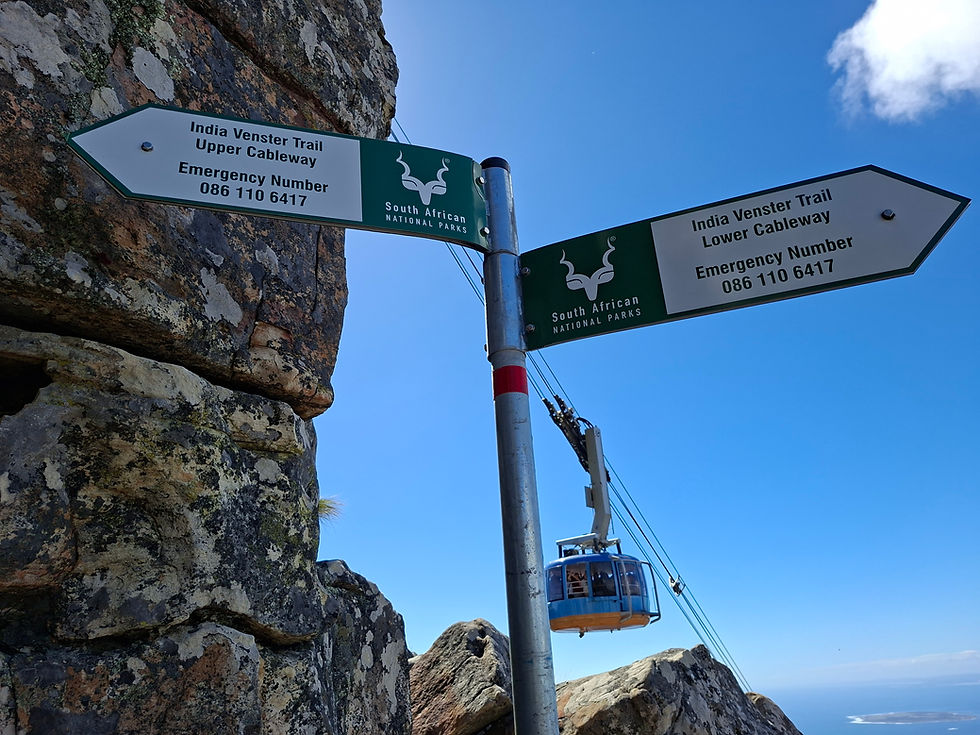
From the very start of the hike, the views opened wide and panoramic, Cape Town spread below, the Atlantic shimmering beyond. Beside us, the famous cable car glided up the mountain: a giant, round cabin suspended from thick steel cables, swaying slightly in the wind. Its wraparound windows covered most of the body, giving passengers a dramatic vantage point as they craned to take in the scenery. Watching it ascend while we climbed on foot added a sense of scale and spectacle to the day.

Ahead of us rose the sheer granite wall of Table Mountain, its rugged face streaked with sparse shrubs clinging to cracks in the rock. At the base stood a green sign marking the India Venster route, a trail notorious for its steep scrambles and exposed ledges. The warning was clear: this path is for experienced hikers only, with safer alternatives like Platteklip Gorge suggested for most visitors. Reading it, I felt both the pull of adventure and the sobering reminder that on Table Mountain, nature sets the terms.

The trail wasted no time in tilting skyward, each step pulling us sharply up the granite flank of Table Mountain. Within minutes, the parking lot below had shrunk to a scatter of dots, the hundreds of cars now no bigger than ants.
We made steady progress up the trail, each step pulling us higher against the sheer granite cliffs that loomed above. The rock face was daunting, vast slabs of stone layered and cracked, with tufts of hardy shrubs clinging wherever they could.
Below, Cape Town sprawled like a miniature model, the cars in the lot reduced to specks. The weather was perfect: a bright blue sky streaked with drifting clouds, sunlight bouncing off the Atlantic and Lion’s Head rising proudly to one side.
At a distance behind Lion’s Head was Robben Island, looking peaceful and beautiful, but hiding the fact that for 18 years Nelson Mandela was imprisoned there during apartheid, a place of harsh isolation that shaped South Africa’s long struggle for freedom.
Far above, the cable car station perched at the summit looked almost like a castle in the sky, a modern Xanadu crowning the mountain. I stepped carefully, aware that one misjudged move on the uneven stone could mean injury, but the grandeur of the climb kept pulling me forward.

Soon the trail tilted into a near‑vertical section, the granite wall rising straight above us. The only way forward was to spot the painted yellow shoe‑marks, each one leading to the next foothold or handhold. It felt like a puzzle, connecting the dots across the rock face.
In some places, iron staples were bolted into the stone, just like on a via ferrata route in the Alps, giving climbers a secure grip where the rock offered none. The combination of painted markers and metal rungs turned the ascent into a mix of hiking and scrambling, demanding both focus and nerve.

As the route steepened further, the trail offered more than just painted shoe‑marks. In certain exposed sections, iron staples bolted into the granite were accompanied by heavy chains hung alongside them.
Gripping the cold metal, I edged upward, hanging on for dear life while navigating narrow ledges and vertical scrambles. The combination of chains and staples turned the hike into something closer to a mountaineering route than a casual walk, demanding both strength and nerve.
Each secure hold was a relief, each step a reminder of how unforgiving Table Mountain can be and how exhilarating it feels to meet it head‑on.

From the vantage point near the top, the city unfolded beneath us in dazzling detail. One landmark stood out immediately, the huge, round Cape Town Stadium, gleaming white by the shoreline. Built for the 2010 FIFA World Cup, it now hosts concerts, rugby, and football matches, its oval shape a striking contrast to the rugged slopes of Table Mountain.
Beyond it stretched the Atlantic, shimmering under the afternoon sun, while the city’s streets and neighborhoods radiated outward like veins from the mountain’s heart. The mix of granite cliffs, ocean horizon, and modern architecture made the view feel both timeless and contemporary.

As we climbed higher, the panorama widened until the ocean itself seemed to stretch forever. Out on the water, I could make out Robben Island, small yet unmistakable, lying just off the coast. Its history as the prison that held Nelson Mandela for 18 of his 27 years gave the view a weight that contrasted sharply with the sparkling sea around it. From this height, the island looked serene, almost ordinary — but knowing its past made it one of the most powerful sights of the ascent.
The climb grew tougher, with some yellow shoe‑marks painted directly onto vertical rock faces, forcing me to stretch and scramble to reach them. Narrow passages opened suddenly to breathtaking views, natural rock windows framing Lion’s Head peak on one side and the shimmering Atlantic on the other.
The granite walls towered above, their rugged textures broken only by tufts of grass and the occasional small tree clinging to life in the cracks.
My friend, super‑fit and charging ahead, was already far out of sight, while I made slow, deliberate progress. Along the way I passed three South Africans of Indian descent, early in their thirties, who had struck fortune in water purification technology and retired young to pursue adventure.

The ocean stretched endlessly, its deep blue horizon merging with the clear sky while a craggy part of the table mountain extended in front of me directly opposite the lion's head.

Going higher up, the view spilled outward to a coastal town laid neatly along the shoreline, its white‑roofed buildings arranged like tiles against the deep blue of the ocean. A sandy beach curved gracefully along the edge, waves breaking in bright surf, while green hills framed the settlement from behind.
It was a scene where rugged nature and human design coexisted in harmony. I’ve read that the journey is the reward and here, I felt constantly rewarded, each turn of the trail unveiling another panorama of cliffs, sea, and city, a tapestry of natural grandeur and man‑made artifacts.

I arrived at a small ledge, the granite pressing close around me, and suddenly the yellow shoe‑marks vanished. I looked left, then right, craned upward, even glanced down — but there were no signs to follow.
The narrow passage dropped away into breathtaking views, yet the absence of markers made the climb feel precarious. For a moment I stood still, weighing my options, aware that one wrong move could mean trouble. My friend was far ahead, the trail demanding my full focus, and I realized that on Table Mountain, progress often comes with moments of doubt.
The mountain dealt me a stalemate. I was stuck unable to move up or down. The ledge was steep, slippery, and offered no purchase for hands or feet. Fear struck hard, freezing me in place. For a few minutes it felt as though I might be trapped there forever, suspended between granite and sky. The silence deepened the sense of isolation; no other hikers were visible, my friend was far ahead, and I was utterly alone. Table Mountain had stripped away all illusions of control, leaving me face‑to‑face with raw vulnerability.
After what seemed like eternity, I gathered enough courage to jump to a nearby ledge, with my heart in my throat. That small act enabled me to make progress, but in the opposite direction, going back to the starting point. I accepted defeat and continued walking down.

A few minutes into the descent, I bumped into a young Dutch couple. We traded quick stories, I shared my fresh slip‑and‑slide experience, and they laughed, saying they’d done this hike many times before. They kindly invited me to rejoin them on the climb back up, but I was already committed to the fast track down. Within no time I was back at the starting point, prosecco in hand, savoring the fizz as a small "almost" victory toast.
My phone buzzed with a WhatsApp call: my friend, triumphant at the summit, reporting it would take him two more hours to descend. I smiled at the contrast, his slow, careful return versus my "fake" celebratory glass already half‑empty.
With the wait ahead, I summoned an Uber and drifted into town, where the evening closed with a seafood dinner that felt like the perfect punctuation mark to the day’s chaos. The salt of the ocean on the plate, the hum of the restaurant, and the quiet satisfaction of having chosen my own rhythm, it all blended into a memory that was less about the summit and more about the journey’s flavor.

That night, my friend suggested we set alarms for 4 a.m. and chase the sunrise from Lion’s Head. Bleary‑eyed but game, we drove through the quiet streets to the trailhead. To our surprise, hundreds of cars were already lined up, headlights cutting through the dark as fellow hikers gathered with headlamps. The mountain had become a pilgrimage site, a communal ritual of watching the first light spill over the Atlantic.

The climb began in silence, broken only by the crunch of gravel and the occasional conversations drifting from groups ahead. The view was dramatic, dark mountain silhouettes etched against the glow of the city’s lighted edifices, the bay shimmering faintly, and scattered trees standing like watchmen along the slope.

Every so often I paused to take pictures, the city lights below shimmering like a necklace. My friend pressed on diligently ahead and soon disappeared into the dark switchbacks.

The dawn light was beginning to spill across the horizon, painting the far‑off mountains in soft hues of pink and gold. I was only halfway up, but the trail was already whispering its challenge. Other walkers, clearly regulars, passed by with easy rhythm, warning that the hardest stretch was still ahead. Their voices carried a mix of camaraderie and caution, reminding me that Lion’s Head was not just a casual stroll but a climb that demanded grit.

Clusters of hikers moved together, their headlamps bobbing like fireflies against the dark rocks. The yellow arrows painted on stone pointed the way, but the uneven steps and jagged boulders made progress slow.

Some parts were vertical and had staircases to slowly and carefully ascend.

The soft dawn sun was lighting the hill up front, casting a gentle glow that turned the rocky slope into a stage. A few hikers had already claimed their vantage points, perched on ledges and boulders, waiting for the sunrise to unfold.

There was more to be climbed. The path grew rougher with stretches that demanded hands as much as feet. Some sections had crude stairs carved into stone, while others offered metal strings bolted into the rock face.

The glow of the sun was more visible now and the city below was waking up.
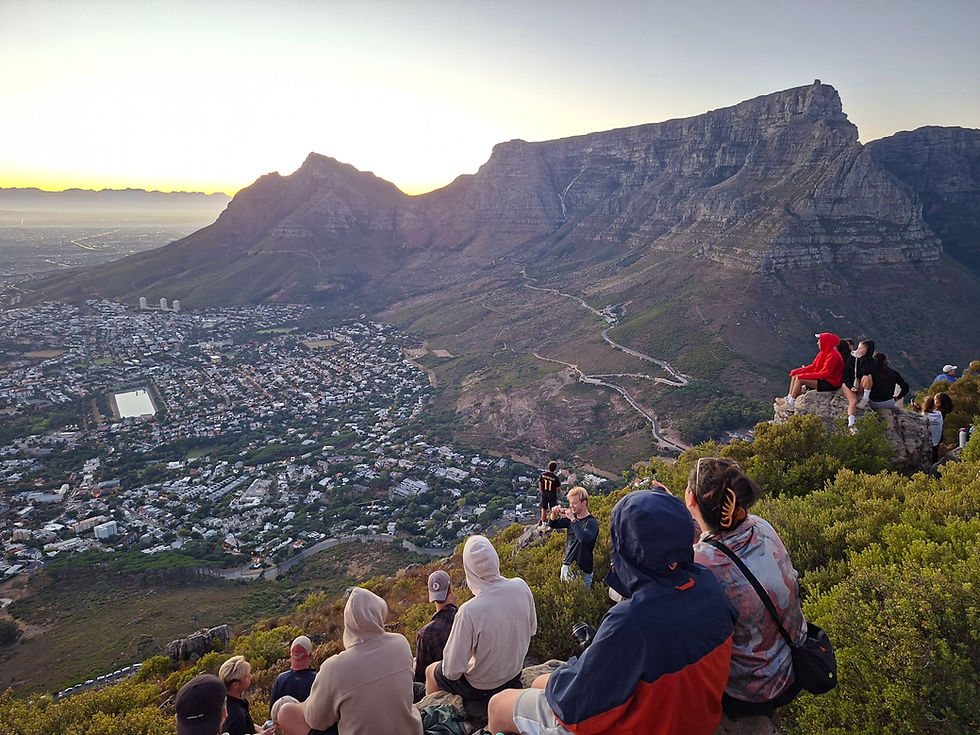
The Table Mountain was visible ahead, its flat top etched against the softening sky. All along the ridges, people had camped out at their favorite sunrise view spots, blankets spread, cameras ready, some sipping coffee from thermos flasks. The show was about to begin.

And suddenly, the moment everyone awaited arrived. A blaze of orange and gold spilling over the ocean, washing the city below in soft light. Table Mountain stood proud in silhouette, its flat summit glowing at the edges, while the bay shimmered.
It was spectacular, not just the sunrise itself, but the shared awe of hundreds of strangers gathered on rocky ledges, united by the simple act of watching the world wake.
My friend was hidden somewhere among the crowd at the summit, but I lingered just long enough to soak in the vibe, the chatter, the laughter. Eventually, I began the descent, the trail now bathed in daylight and far less intimidating than it had seemed in the dark.
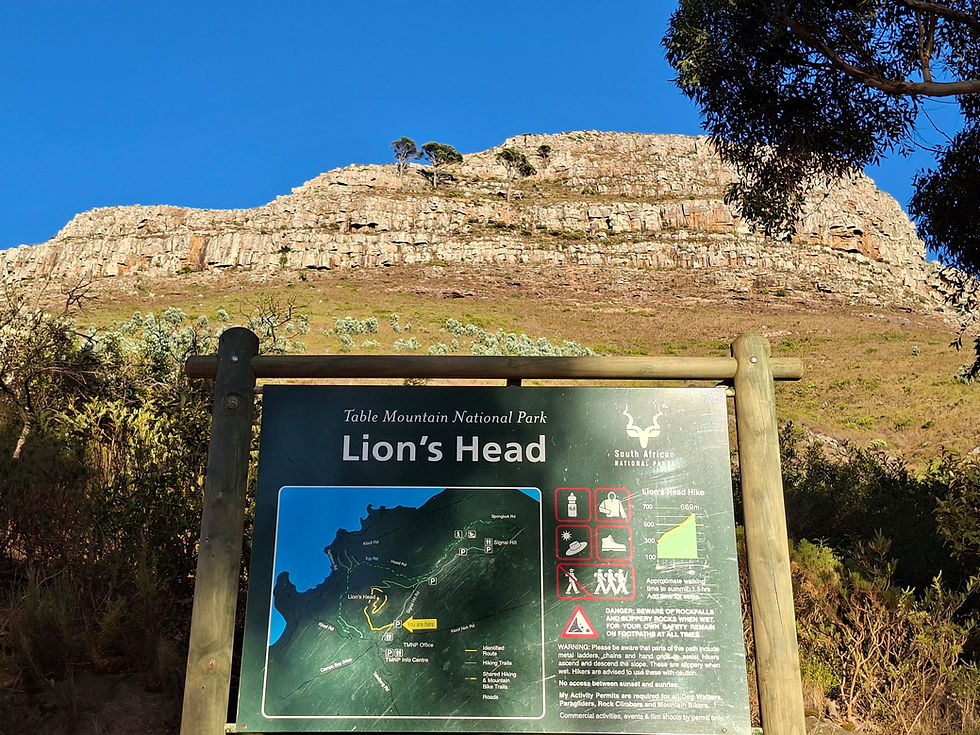
At the base, the familiar wooden placard stood waiting, announcing the hike with its map and safety reminders.
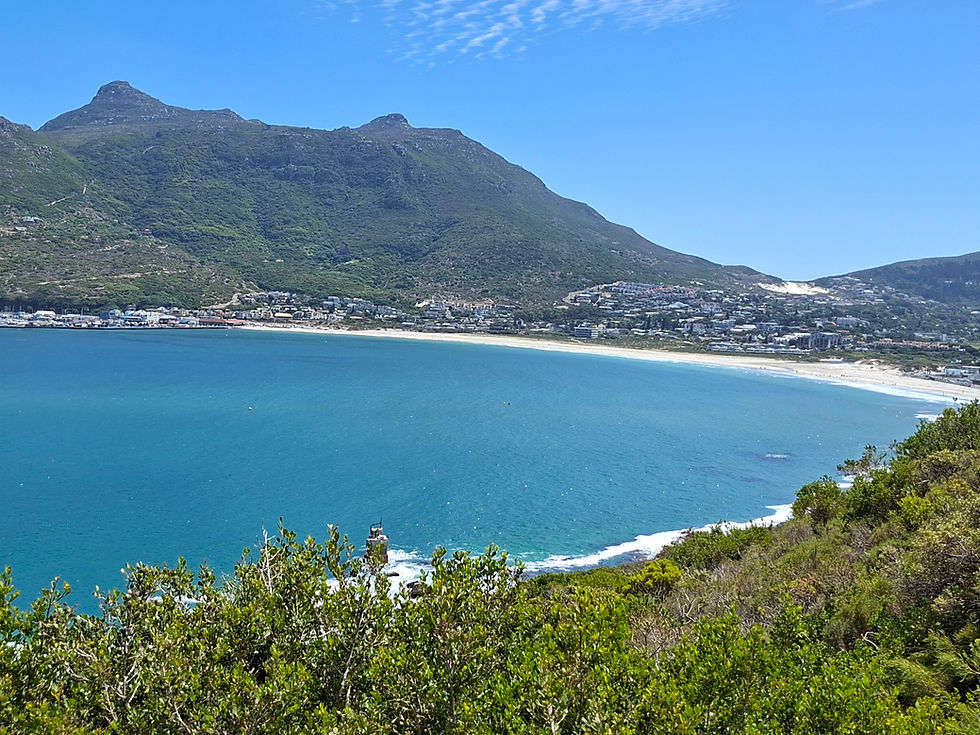
With the hike done, we rewarded ourselves with a sumptuous breakfast at the Hyatt. We set out on the Cape of Good Hope drive, a route that promised rugged cliffs, sweeping ocean views, and the sense of standing at the edge of the continent.
The road wound past beaches and fishing villages, each turn revealing a new panorama with azure waters and waves crashing against jagged rocks.

We were not shy about stopping often to take pictures.
On the way, we came across a striking sight, a decommissioned submarine displayed on land, its black hull resting on concrete blocks, the red “S99” marking still visible on the sail. It looked both formidable and strangely out of place, a vessel built for stealth now standing exposed under the open sky. The metal staircase alongside hinted at its new role: not as a weapon of war, but as a museum piece, inviting visitors to step closer and imagine the life of sailors who once served within its narrow corridors.

Simon’s Town marina was a picture of calm, rows of sailboats and yachts resting quietly in the water. The bay reflected the morning light. In the foreground, bursts of red blossoms framed the scene, adding a splash of color to the nautical whites and silvers.

In Simon’s Town, I stopped at one of the most endearing memorials along the harbor, the bronze statue of Just Nuisance. Perched proudly on a rock, bowl at his paws, he looks ready to spring back into life. This Great Dane became a legend during World War II, the only dog ever officially enlisted in the Royal Navy. He was loved by sailors for escorting them on trains, often without tickets, and for his loyal companionship aboard ships. To solve the problem of his constant stowaway antics, the Navy formally signed him up, giving him the rank of Able Seaman.

In February 1940, the County Class Cruiser HMS Cornwall was dry‑docked at Simon’s Town. As tradition dictated, her crew painted the ship’s badge on the dock wall — a mark of presence that still lingers today. Two years later, on Easter Sunday 1942, Cornwall was sunk west of Ceylon by Japanese dive‑bombers. Nearly 200 men were killed or went missing, including 23 South Africans, while 550 survived the attack.
Decades passed, and in 2007 a bulldozer operator working in Simon’s Kloof uncovered something extraordinary: a large stone bearing the badge of HMS Cornwall, sculpted with care and dated 1946. The initials carved into it, APJ, deepened the mystery. Was it the work of a survivor, perhaps memorializing fallen comrades? The Simon’s Town Historical Society searched for answers, even noting that one survivor’s initials were PAJ, tantalizingly close to the engraving. But no definitive link was ever found.
The stone was eventually moved to Jubilee Square in 2013, its badge colors restored, where it now stands as a quiet enigma. Was it a survivor’s tribute, a craftsman’s commission, or something else entirely? No one knows for sure. What remains is a carved reminder of courage, loss, and the enduring mysteries of wartime memory.

Next on the agenda was the visit to Boulders Beach Penguin Colony and it turned out to be a fantastic experience.

Right near the entrance to the park were hundreds of penguins. They seemed to be relaxing and hanging out without a care in this world.

Some of the penguins were in small caves in the sand.

Seeing them in their habitat, we enjoyed being in their presence and watched their actions with curiosity.
After a couple of hours, we realized we must hurry to see the cape of good hope before the end of park hours.

Along the drive, we stopped at an interpretive sign about Fynbos, the unique vegetation of the Cape Floral Region. The board explained how this ecosystem thrives only in Mediterranean‑type climates, with the Cape Peninsula being one of the richest biodiversity hotspots on earth. Proteas, ericas, and restios were highlighted as signature plants, each adapted to the dry summers and wet winters.

We did a small hike to see the spectacular ocean views and cliffs.
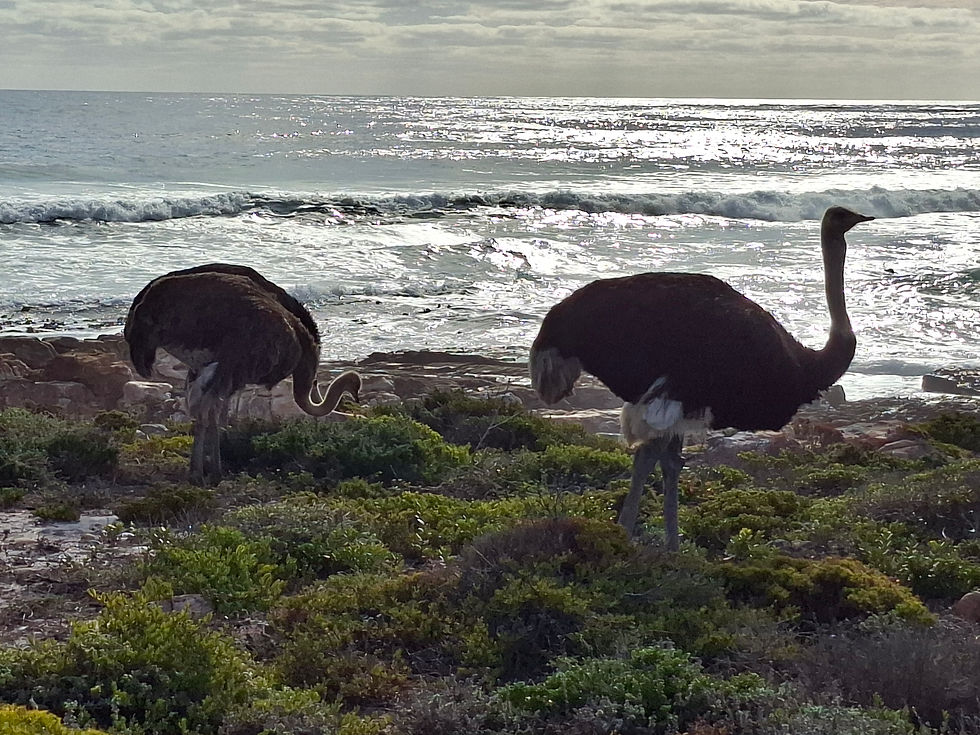
As we drove further, there were three large ostriches that caught our eye. They were feeding by the seashore.

We decided to walk to see the ostriches up close and stumbled on the vivid red flower called the red Babiana. It’s a striking coastal species with recurved scarlet petals, adapted to sandy dunes and rocky outcrops, and pollinated by sunbirds.

Although they were scary looking and large, we were able to get within a few feet of the ostriches.

Amid the Cape’s coastal vegetation, a patch of shrubbery revealed its own quiet complexity. Long, segmented green stems stretched outward like living threads, their surfaces dotted with tiny nodes that caught the light. Around them, broader waxy leaves formed a protective backdrop, while clusters of yellow‑orange buds glowed softly in the corner, hinting at fruit or flowers soon to emerge.
It was a tangle of textures, wiry, succulent stems intertwined with smooth foliage, all rooted in sandy soil scattered with twigs.

The cape was close and we parked the car and walked on the rocky coast.

Hundreds of people were there, and many were taking pictures of the unique location of the cape.

After a short hike around the hill flanking the Cape, we got back into the car and drove a little further. Suddenly, the landscape shifted, dry grasslands stretched out, dotted with patches of green. Out of nowhere, an animal appeared, towering above the shrubs. At first glance it seemed almost too large to be real, but as we slowed down, we recognized it: an eland, the largest of the antelopes.
Its spiraled horns caught the light, and the heavy dewlap hanging from its neck gave it a regal, almost ancient presence. Muscular yet calm, it stood watching us, perfectly at ease in its domain. The encounter felt like a gift, a reminder that the Cape is not only about ocean cliffs and floral diversity, but also about the quiet majesty of wildlife that roams freely across its rugged terrain.

The lighthouse was next on our path. We drove quickly, the road winding through rugged cliffs and windswept vegetation, hoping to make it before the park gates closed. The late afternoon light stretched long shadows across the Cape, and the ocean below churned with restless waves.

At the end of the drive, the lighthouse stood tall, perched defiantly against the elements, a sentinel watching over the meeting of two oceans. Its white walls gleamed in the fading sun, and the climb up to it felt like a race against time.

The views were spectacular, golden light spilling across the ocean, cliffs glowing as if lit from within, and the beach below shimmering like a hidden jewel. From the lookout, the headland stretched boldly into the sea, waves breaking against its rocky edges while the sun streamed through scattered clouds. It was the kind of scene that silences you, where the drama of sky and water meets the ruggedness of land in perfect balance.
We took pictures of the lighthouse, its white walls glowing in the late sun, and then climbed onto a massive boulder nearby. From that perch, the view opened wide, jagged cliffs plunging into restless waves, the rocky terrain stretching out like a natural amphitheater.
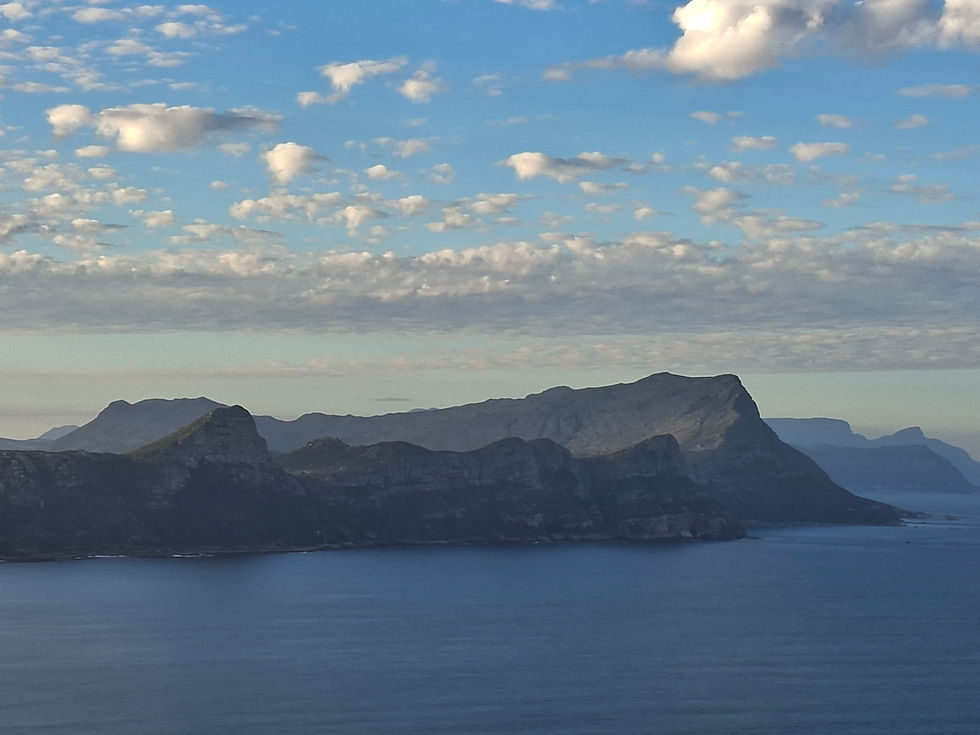
It was time to leave. The views were majestic in any direction we looked.

Racing against time we drove fast to exit the gate before it closes but took pictures as we drove.

Breathing a sigh of relief when we came to the gate and found it open, we concluded the cape visit.

The sky had taken on a painter’s palette, clouds stretched into unusual shapes, brushed with pinks and purples that softened into gold. The vegetation below looked distinctly Cape-like, hardy shrubs and small trees silhouetted against the glowing horizon.
It was a fitting close to a whirlwind trip: hikes, wildlife encounters, lighthouses, penguins, and coastal drives all compressed into a short time, yet each moment vivid and memorable.
Standing there, we felt the satisfaction of having seen and done so much in such a short visit. The Cape had given us its drama and its quiet beauty, and as the colors deepened across the sky, happiness settled in, the kind that comes from knowing a journey has been full, rich, and unforgettable.


Comments