Lesotho & Sani Pass
A landlocked country completely contained within South Africa; Lesotho had been on my list for years. I finally paired the visit with nearby adventures in Uganda and Rwanda, stitching together a trip that crossed both altitude and culture.
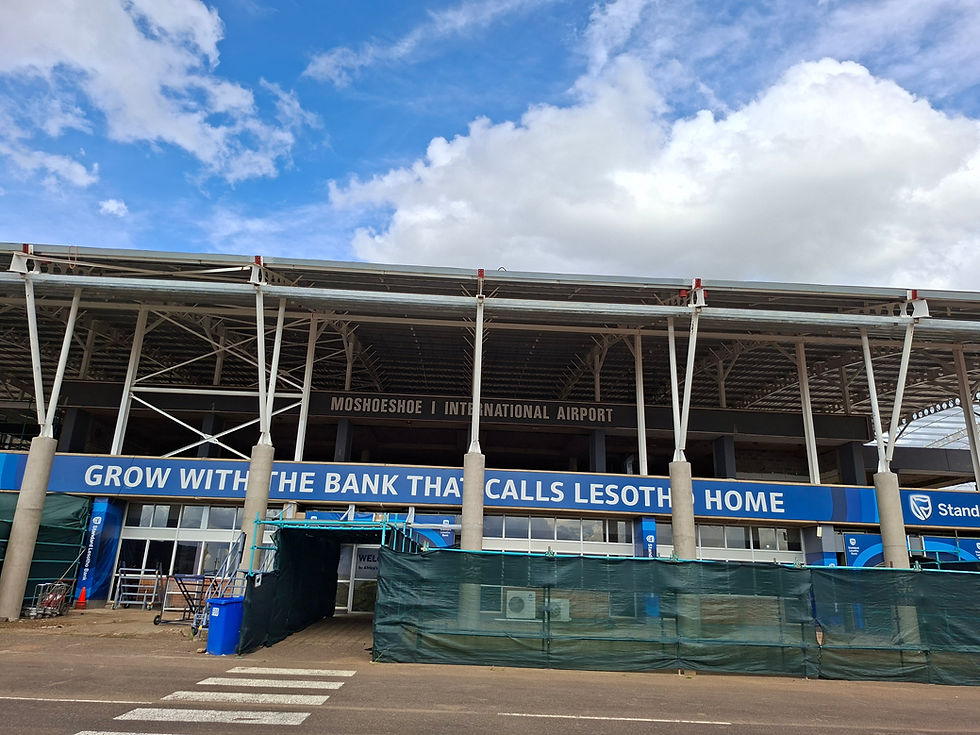
My original plan was to drive from Johannesburg, but websites warned me about the bureaucracy of taking a South African rental car across the border, the paperwork, the permissions, the cross‑border fees. I abandoned the idea of a road entry and instead boarded a short flight from Joburg to Moshoeshoe I International Airport, the gateway to the Kingdom in the Sky.

The small Embraer jet of Airlink brought me and my Buffalo‑NY friend into Maseru, the capital of Lesotho. Immigration was simple, just one official stamping passports as we walked past his desk. On the other side, in the dimly lit arrivals hall, a woman ran a tiny car‑rental counter.
Within minutes, we had the keys to a small car for $120 for three days, and the Kingdom in the Sky was suddenly ours to explore.
Lesotho is a compact mountain kingdom of about 30,355 sq km, home to roughly 2.3 million people. It is a constitutional monarchy headed by King Letsie III, while the day‑to‑day government is run by a Prime Minister, currently leading the elected administration.
The country’s GDP hovers around USD 2.5 billion, reflecting both its challenges and its resilience as a high‑altitude nation. Lesotho gained its independence in 1966 from the United Kingdom, stepping into the world as one of the few countries entirely above 1,000 meters (3,000 feet), a true Kingdom in the Sky.

Using Booking.com, we had found an entire apartment in Maseru for $122 for three days, an unbelievable deal for a capital city. The drive from the airport took about an hour, and Google Maps mostly cooperated. Since my iPhone had been robbed just days earlier in Uganda, the homeowner’s messages were not reaching us.

When we finally pulled up to the address, a kind neighbor stepped outside, took one look at our confused faces, and immediately called the homeowner. Within fifteen minutes, she arrived to greet us. The house turned out to be large, modern, and surprisingly elegant, and the host couldn’t have been more helpful.

Just outside Maseru stands a striking stone church, its twin towers rising cleanly into the blue Lesotho sky. Palm trees line the front, softening the otherwise solid, fortress‑like architecture. Taxis idle nearby, hinting at the steady rhythm of daily life that flows around this landmark.

We had risen early with a single goal in mind: to see Maletsunyane Falls, the tallest and most dramatic waterfall in Lesotho. It lay roughly 120 km away from Maseru, a journey that would take about three hours each way, winding through highland roads that climbed steadily into the sky. The round‑trip would be long, but the promise of seeing the country’s most iconic cascade made the early start feel worthwhile.

We drove through rolling green meadows dotted with wildflowers, the colors shifting with every bend in the road. Mountain ranges rose and fell in long, gentle waves, and every so often a standalone peak would appear, a perfect cone of rock and grass rising straight out of the earth like a sentinel.
Traffic was almost nonexistent; most of the time it felt as if we had the entire highlands to ourselves. The road stretched ahead in long, straight lines, giving us a clear view of what lay before us for ten miles at a time.
From a far distance we noticed two mountains with tiny sub‑peaks perched on top, a formation that made us giggle. A few kilometers later, Lesotho proved it shared our sense of humor. Locals had set up a bright yellow selfie frame marking the spot, proudly naming the formation Thabana‑li‑Mmele, which literally means “Breasts Mountain.” The frame even included the GPS coordinates, as if inviting every passing traveler to stop, smile, and immortalize the joke. It was one of those moments where landscape, culture, and playfulness blended into something unforgettable.

The Maletsunyane Falls did not disappoint. It looked enormous, a sheer wall of water dropping in an uninterrupted 192‑meter plunge, one of the tallest single‑drop waterfalls in all of Africa. The roar echoed across the canyon, and the spray drifted upward like a ghost rising from the gorge.
We started the long drive back after grabbing some drinks at the huge Maletsunyane Falls Lodge restaurant perched on the opposite side of the gorge, a cavernous space with sweeping views, in which we were the only customers.
On our way back, the grasslands opened up in long, gentle waves, and we were treated to a surprising parade of large birds. A vulture hunched over the grass as if guarding a secret, an elegant ibis probed the ground with its curved beak, and a tall hadada strutted through the meadow with its unmistakable silhouette. It felt like Lesotho was giving us a final wildlife send‑off, quiet, unhurried, and completely unexpected.

That store sign on the way back made me smile, a half‑finished building with a bold, overconfident name splashed across the front, as if ambition alone could will it into existence. It was one of those perfectly Lesotho moments: a mix of earnestness, humor, and everyday life unfolding against a backdrop of mountains and open sky.
The evening was gentle and glowing, a full moon rising over a sky brushed in pink and purple as we re‑entered Maseru. We headed straight to the swanky Pioneer Mall, home to the lively News Café, its lights and music spilling warmly into the night air.
Dinner was excellent, attentive servers, good food, and that relaxed capital‑city energy that felt worlds away from the quiet highlands we had just driven through.

The next morning promised an even bigger undertaking: a 260 km round trip, roughly seven hours of driving, as we set out toward the legendary Sani Pass, the rugged mountain route that links Lesotho to South Africa. It was going to be a long day, but the kind of long day that becomes a story.
True to its name, this mountain kingdom unfolded in a series of shifting vistas, mountains stacked in blue‑green layers, deep valleys carved by rivers, wide plateaus catching the morning light, and endless stretches of shrubs and greenery swaying in the wind.
Every few minutes the landscape changed character, as if Lesotho were flipping through its own portfolio of high‑altitude moods.
We passed countless mountain passes, waterfalls tumbling down distant cliffs, wide water reservoirs shimmering in the sun, and an impressive network of roads threading their way through valleys and ridgelines. Every turn revealed a new layer of the highlands, as if Lesotho were quietly showing off the full range of its rugged beauty.

That truck in front of us made us instantly tense, a hulking metal box plastered with warnings, crawling up the mountain road as if daring us to stay behind it. The narrow pass and the steep drop on one side made us feel boxed in, our little car suddenly very small.
A quick, well‑timed maneuver finally got us past it, and only then did we exhale, laughing at how relieved we felt to put as much distance as possible between us and a vehicle boldly advertising its explosive personality.

Sometimes we had to come to a complete stop when herds of lambs decided to wander across the 8,000‑plus‑foot‑high highways, utterly unbothered by traffic or schedules. They owned the road, and we were just visiting.
Water is one of Lesotho’s biggest exports, they sell it to South Africa, feeding Gauteng’s thirsty cities through the vast Lesotho Highlands Water Project.
Along the way we saw major construction underway: huge new bridges and channels being built to reroute and accelerate water flows as part of the project’s next phase.

Soon we came to the highest point of the road at 3,240 m (10,630 ft), which is just shy of the country's actual highest peak, Thabana Ntlenyana, at 3,482 m. There were some locals from the Basotho tribe waiting around for talking to tourists or taking pictures.

Sani Pass was only minutes away. Hairpin bends came one after another, each curve revealing a fresh sweep of mountains and valleys. Guardrails clung to the edges, and the gateway to Lesotho was just ahead. The climb was less about speed and more about rhythm, switchback after switchback.

For miles there was nothing but mountains and the solitary ribbon of road threading between them. The valleys opened wide, the ridges rolled on endlessly, and the silence of the highlands pressed in from all sides.

Soon a sign announced that we were at our destination. At 2,873 meters, the gateway to the Mountain Kingdom stood proudly, draped in Basotho colors and tradition. The bold letters, Welcome to Lesotho, felt like both a declaration and an embrace.
After the bends, the long stretches, and the silence of the highlands, this marker was the threshold to a new rhythm of life.
The border area had a guard who told us that if we drove through the gate into Lesotho, we would have to pay a cross-border vehicle fee. He recommended it was best to park nearby and explore the immediate border area on foot instead.

The pass was visible in front of us: green and undulating ground with mountains on each side. This pass is important because it began as a historic 20th-century bridle path where Basotho traders walked pack mules laden with wool and mohair down the cliffs to trade for maize meal, blankets, and clothing in South Africa

We walked to the edge of the pass and watched the big white van shrink to a toy against the vast slope. The road was sandy, unpaved, and seemed to fight for space as the grass pressed in from all sides. Clouds and mist gathered above, hinting at an afternoon storm that would soon sweep across the highlands. Standing there, it felt as if the mountain was reminding us who truly owned the land.
Just as the clouds thickened, four Swedish ladies appeared, climbing up from the South Africa side. They didn’t look like hikers, chic clothes and light shoes gave them away, but their determination was unmistakable.
Their tourist van had broken down far below, and rather than wait in the stranded vehicle, they trekked two kilometers uphill to reach the pass.

Nearby stood the highest-altitude bar in the world, a place we had hoped to duck into for a quick drink. But the guard at the gate was firm, without a reservation, entry was impossible. We tried to explain, to bargain for just a moment inside, but he did not budge. The irony was sharp: after winding roads, mist, and mountain silence, the one thing we couldn’t conquer was bureaucracy at the top of the pass.
We came upon a round stone hut with a thatched roof, where a couple of Lesothoans welcomed us warmly. Inside was a small heritage museum, simple but rich in spirit. Handcrafted trinkets lay on a table outside, each piece carrying the imprint of Basotho culture.
On the side of the highway, we saw a large group of people carrying sticks, walking together across the fields and singing in Basotho. Their voices rose in rhythm, echoing against the terraces, and the scene felt like a ceremony, part celebration, part tradition. The dark patterned garments, bead necklaces, and feathered headpieces gave the gathering a sense of solemn beauty.

At nearly 10,200 feet, we reached the entrance to the Letšeng Diamond Mine, the highest diamond mine in the world. The sign stood against the rugged hills, marking a place where ordinary rock yields extraordinary gems. Not small‑scale, river‑panned stones, but high‑quality, industrially mined gems.

This mine is renowned for producing some of the largest diamonds ever discovered, including the 910‑carat Lesotho Legend. Standing there, it was striking to think that beneath this alpine tundra lies a treasure trove that has rewritten diamond history.
Another hour ahead lay Afriski, the only ski resort in Africa. Active during the winter months of June to August, it offered chalets, a restaurant, and sweeping views of the Maluti Mountains. Standing there, it was surreal to imagine skiing on the African continent—proof that Lesotho’s highlands hold surprises as dramatic as its passes.
A few more hours of driving brought us back to Maseru, where we enjoyed a good dinner in the Pioneer Mall, savoring the last flavors of the Mountain Kingdom.
Lesotho is a charming small country, wrapped entirely within South Africa yet carrying its own proud identity. From the hairpin bends of Sani Pass to the sweeping highland vistas, from heritage huts to diamond mines and even Africa’s only ski resort, the journey revealed both rugged landscapes and rich traditions. I was glad to have visited, to enjoy its beauty and to glimpse the rhythm of life in the Mountain Kingdom.
Early the next morning, we set off for Johannesburg, ready for the next adventure. At the airport, an unusual sight greeted us, old aircraft displayed right beside the active runway, a curious blend of history and modern travel. It felt like a fitting send-off, a reminder that every journey is layered with past and present, waiting to be carried forward.


Comments