The Kerry Way, Killarney
While looking for a long hike to do in Europe, I found out about the Kerry Way, which starts from Killarney, a charming little town in the south‑west of Ireland, in the Ring of Kerry area. The hike is 214 km long and runs through some of the most remote and peaceful landscapes in the country.
In anticipation of doing the hike in June, I started searching for hostels and B&Bs along the route, but nothing seemed to line up neatly with the daily stages. I was close to giving up when I came across Hillwalk Tours, a company that organizes hikes in many parts of the world. I contacted them, and they handled everything, booking B&Bs, providing detailed daily instructions, arranging pickups and drop-offs when accommodations were far from the trail, and even taking care of baggage transfers. It made the whole plan suddenly feel possible.
Arriving in Dublin, I learned that I needed to take the green bus from the Red Cow Luas stop, a long but convenient 4.5‑hour ride that would bring me straight to Killarney for about €26 fare.
The bus wound its way through many small towns and then through Limerick before finally reaching Killarney at around 8 p.m., slightly behind schedule. Not that it mattered, sunset was close to 10 p.m., giving me plenty of daylight to walk the twenty minutes to the first B&B Hillwalk had arranged for me.
By this time I was absolutely famished, the kind of hunger that makes every doorway promising. That’s when I spotted The Irish Whiskey Experience, with its restaurant tucked neatly beside it. Inside, the entire wall was a shimmering mosaic of Irish whiskeys, every label, every region, every shade of gold you could imagine. They even poured a perfectly creamy Guinness; this is Ireland, after all.
With a full stomach, I walked the final fifteen minutes of the day’s journey to the first bed and breakfast arranged by Hillwalk Tours, a quiet, welcoming stop that felt like it had been waiting just for me.
The morning began with a sumptuous plate of scrambled eggs and smoked salmon. A few other couples were gathered around the small dining room, one from Hungary, another from the US, and we traded the usual traveler stories over coffee.
Soon a tall man named Dux appeared at the door, cheerful and unhurried in that distinctly Irish way. He announced that he’d be driving me to Ross Castle, where a boat would be waiting to take me across the lakes to Lord Brandon’s Cottage in the Black Valley. It sounded almost mythic when he said it, castle, boat, valley, as if the day ahead were less a hike and more a chapter from an old Irish tale.

My boat that morning was an unexpectedly lively one, seven schoolchildren, their teacher, and two travelling ladies from Los Angeles who looked both amused and slightly overwhelmed by the Irish energy around them. The lads had an endless supply of questions about the USA, everything from Hollywood to hamburgers.
The conversation was nonstop, a cheerful back‑and‑forth that filled the entire two‑hour ride. And honestly, it was exactly what I needed. I’d been feeling that familiar anxiety to get started on the hike, the itch to be on the trail, moving, making progress, but the chatter on the boat dissolved it.
A little farther along the lakes, We came across the story of Innisfallen Monastery, a quiet reminder of how deep the roots of this landscape really go. The island was first settled in the 7th century by St. Finian the Leper, who brought monks here seeking peace and seclusion on the still waters of Lough Leane.
That peace didn’t always last, Vikings raided the island more than once, and later the O’Donoghues, yet the monks kept returning, rebuilding their sanctuary each time. By the 12th century the Augustinian Canons had taken over, turning it into a respected center of learning where the famous Annals of Innisfallen were compiled. Today, parts of the abbey church still stand: a 12th‑century Hiberno‑Romanesque doorway carved with chevrons and weathered animal heads, and inside, a small stone cross once lost to the lake.
Ireland is green in a way that feels almost exaggerated. Everywhere my gaze landed, hills, islands, even the distant shoreline, was wrapped in that deep, comforting green.
The Lakes of Killarney are vast, especially Lough Leane, which spreads out over nearly 19 square kilometers, wide enough that the two‑hour boat ride felt like crossing a small inland sea. The entire two‑hour ride felt like drifting through a moving postcard.
Any impatience I had about starting the hike softened into simple awe; with scenery like this, you don’t rush, you just soak it in. By the time we reached the pier near Lord Brandon’s Cottage, I felt lighter, and ready to start this hike, that I had planned for so long.

Hillwalk had also given me access to my entire itinerary inside the Hiiker app, which quickly became my quiet little companion on the trail. Everything I needed was there, the day’s route, the elevation profile, my exact heading, and even the ability to switch between stages with a single tap. It felt reassuring to have the whole journey laid out so clearly in my pocket, especially in a place where the landscape can make you feel wonderfully small and the distances deceptively large.
The trail did not disappoint. It opened up immediately into a shifting palette of greys and greens, revealing one landscape after another as if the valley were turning pages for me. There were quiet streams threading through the rocks, small islands sitting still on the water, long stretches of lake shimmering under a soft sky, and moss‑draped trees that looked as though they’d been collecting stories for centuries. Every few minutes the scenery changed just enough to make me stop, look around, and appreciate how wildly varied this corner of Ireland can be.

I turned a corner and came to a quiet clearing where a few hikers were stopped, their packs resting against moss-covered stones. I struck up a conversation and learned they were a group of ten from Germany, on a three-day hike before heading to Belfast and then Scotland. Among them, a young university student from near Berlin and a pediatric neurologist from Hamburg shared stories of their travels and studies, and since my pace was faster, I slowly moved forward.
As I continued, I passed by mossy trees in enchanted forests, their trunks glistening with dew and age-old secrets. The path wound toward the Torc Waterfall, its cascade roaring like a heartbeat in the wilderness, mist rising in silver veils. Beyond that, the trail opened to the serene expanse of Lough Leane, the lake shimmering under a pale sky, framed by rugged hills and drifting clouds.
Each step drew me closer to Killarney, and somewhere along the way I found myself walking beside two young girls who matched my pace with easy confidence. A bit of conversation revealed they were from Freiburg in the Black Forest, Germany, fresh out of high school and spending their gap year wandering through Europe. What began as small talk quickly turned into a lively exchange, comparing notes on Germany and the US, laughing about the quirks of travel, and bridging a rather generous age gap without even noticing it.
Soon I was approaching Muckross House, its stately stone façade rising out of the greenery. The grounds were alive with color, enormous, perfectly rounded trees, lawns so green they almost glowed, and the gentle clip‑clop of jaunting cars waiting along the path. I wandered through the beautiful gardens at an unhurried pace, eventually settling into their café for an hour, savoring a well‑earned coffee and cake. It was one of those moments where the journey paused just long enough to feel luxurious.

Through a small clearing in the trees, I caught sight of a massive rock rising out of the lake, its dome completely wrapped in dense green foliage like a miniature forest floating on water. Behind it, across the shimmering surface, stood a cluster of elegant estate buildings, their pale stone façades framed by rolling hills.

By now I was nearing Killarney town, the trail yielding o the gentle hum of civilization. A pair of women were walking just ahead of me, and assuming they were locals, I asked them for a dinner recommendation. To my surprise, they turned out to be visitors from Massachusetts, and they were headed to Cronin’s, the very same place my early‑morning taxi driver had sworn by. That settled it; Cronin’s it would be. We passed the red deer statue on the way, a slightly ironic landmark considering I hadn’t seen a single red deer in the forest despite fully expecting one to leap out at any moment.
Dinner was exactly what I needed: fried brie, a half-pint of Guinness, and a generous plate of seafood. Afterwards we wandered through town. Young students were performing with an enthusiasm that made you smile, and Killarney’s town band added its own charm to the evening. It was the perfect finale, a lively, musical welcome back to the world after a long, beautiful day on the trail.
The second day began early. Breakfast was at 7:30 a.m., another hearty Irish spread to fortify the legs, and right on schedule at 8 a.m., Dux appeared again to drive me to Kate Kearney’s Cottage, the official start of the Gap of Dunloe. Today’s route had been billed as the toughest of the entire trip, 27 km of walking and nearly 1,000 meters of climbing.
There were no restaurants or cafés anywhere along the trail, so I packed my survival kit: three protein bars, some cheese, a handful of cashews, and 1.5 liters of water. It felt spartan but sufficient. As I set off, the road was completely empty, not a single hiker in sight.
For a long stretch I walked alone, admiring the still lakes, the thick vegetation, and the quiet ribbon of road that wound deeper into the valley. The mountains ahead looked both inviting and slightly intimidating, but that’s exactly what I had come for.
The weather was spectacular, a rare gift in Ireland, and was expected to hold only until tomorrow. With the next three days forecast to be fully rainy, I decided to savor every moment of sunshine today. About five miles in, the quiet road curved toward a beautiful standalone building, the kind that looks almost too picturesque to be real. A family of four was chatting with a woman beside her car, and curiosity nudged me to stop and ask if there was a café nearby.
“There isn’t,” they lady with the car said with a smile, “but I’ll make you a coffee.”
As luck would have it, she was the owner of the very bed‑and‑breakfast I was standing in front of. Within minutes, she handed me a cup of coffee, unexpected kindness in the middle of nowhere. The family turned out to be from Virginia, on a driving holiday through Ireland, and we stood there talking for ten minutes, enjoying the sunshine, the stillness, and the simple pleasure of exchanging stories.
Coffee finished, spirits lifted, I tightened my pack and continued toward the mountains, grateful for the small surprises that make a long hike feel even richer.
After the major climbs of the day were behind me, the trail settled into a gentler rhythm, though it still had its quirks. I passed gate after gate, each secured with a simple bolt that hikers were trusted to open and close behind them.
In other places, instead of gates, there were wooden stiles, little ladder-like structures propped beside wire fences, inviting you to climb up and over like some rustic obstacle course. It was all part of the charm of walking through working farmland and wild countryside.
As the trail finally leveled into a broad plateau, I came across two German ladies taking a break on a grassy patch. They told me they were also headed to Glencar for the night, staying at the Climbers Inn, which happened to be my destination as well. A little farther on, I met a Dutch couple with the same end point, Glencar was clearly the gathering spot for weary hikers that evening because Susan, the solo hiker from Las Vegas, whom I’d met at the very start of the morning had said that she, too, was staying at the Climbers Inn.
I reached my B&B at 4 PM and took a nap. At 6:30pm, the hostess drove me and the two Indiana University professors staying in my same B&B to Climbers' inn. We had a long dinner and enjoyed the conversation.
The next morning began quietly. After a solid breakfast at the Climbers Inn, I stepped outside and immediately felt the unmistakable drizzle of Irish rain. It had already begun. I pulled off my non‑waterproof down jacket, a completely useless layer in this weather, and realized, with a sigh, that I no longer owned a proper rain jacket. I’d donated my last one in Nepal on my most recent trip, and now the Irish skies were collecting their dues. I resigned myself to being soaked for the day.
That’s when the hostess intervened.
She fetched a big black garbage bag, snipped three holes, one for the head, two for the arms — and in seconds I was wearing the most functional, budget‑friendly rain jacket in County Kerry. It wasn’t pretty, but it worked, and I felt oddly proud of it.
Today was supposed to be an easy one: just 9 miles, a gentle recovery day, leading me onward toward Glenbeigh. Wrapped in my improvised rain gear, I set off down the road, and the rain intensified. Within minutes I was soaked.
To add insult to injury, I checked my Hiiker map, and I was completely off the trail. As a silver lining though, I completely bypassed the hill and walked along the road, thereby giving my legs a break.
I walked through rivers and mansions, lakes and tiny islands, past dense walls of shrubbery and long stretches of solitary road, all of it blurred slightly by the steady curtain of rain. My makeshift garbage‑bag rain jacket held up bravely for a while, but eventually it surrendered, letting the water in from every direction. Soon I was soaked and shivering.
And then, just as I rounded a bend, there it was: “Welcome to Glenbeigh.”
I had finished the day’s walk, and it wasn’t even 12:30 p.m. The rain was still pouring, but the sight of that sign felt like a warm blanket.
Glenbeigh is a small village on the Ring of Kerry, tucked between Caragh Lake, long sandy beaches, and the rising slopes of the mountains. It’s known for its dramatic scenery, sweeping views, forested hills, and quiet roads that make it a natural pause point for hikers and cyclists. The village sits close to Rossbeigh Strand, one of the most striking stretches of coastline in the region and serves as a friendly gateway to the wider Ring of Kerry, with easy access to lakes, trails, and old estate lands.
My B&B hostess in Glenbeigh was wonderfully kind. The moment she saw the state I was in, soaked clothes, dripping shoes, even my hat defeated by the rain, she whisked everything away and put it all in her hot press room to dry. It felt like being rescued.
I crossed the road to Emilie’s, where I treated myself to a steaming bowl of soup, a hearty sandwich, a strong coffee, and a half pint of Guinness. After the cold, wet walk, that simple meal felt luxurious.
The next morning, my hostess prepared a hearty 7:30 a.m. breakfast, blueberries with yogurt, eggs, sausages, ham, sourdough, orange juice, and a strong cup of coffee to anchor it all. I set out around 9 a.m. for what was meant to be a moderate day: 20 km with about 400 meters of climbing.

Right at the outset, I ran into Susan, the solo hiker from Las Vegas. She was heading into the Fairy Forest for a gentle wander and taking the rest of the day off. We chatted briefly before parting ways.
Up ahead, the path tilted into the hills and suddenly the woods shifted into something more whimsical, the Fairy Forest. Tall trees and thick ferns created a green, enchanted hush, and tucked among them were tiny surprises: miniature fairy houses, each perched on little posts like magical mailboxes.
One was painted as a hospital, another as a movie theatre, and others were decorated with vines, flowers, and bright shutters. A larger fairy cottage stood by the trail, cheerfully announcing the entrance to this enchanted corner of the woods. Even a wooden sign invited hikers to “let a fairy take all your worries away.” It was playful, unexpected, and charming, a small burst of imagination in the middle of the Kerry Way.
It wasn’t raining, but the clouds hung low and heavy, wrapping the hills in a soft grey mist. It actually felt good to walk in that quiet, muted world, cool air, damp earth, and the steady rhythm of climbing.
After about three hours, just below the crest of the hill, I spotted the Indiana professors I’d met earlier. They were almost at the top and told me they were finishing in Cahersiveen/Foilemór, same as me, and had already made a reservation at QC’s Seafood Restaurant, which everyone claimed was the best in town.
They invited me to join them, and I happily agreed. The thought of good company and a great meal at the end of a long, misty walk felt like the perfect reward waiting on the other side of the hill.
The trail narrowed into a quiet green tunnel, ferns brushing my legs as I walked deeper into the misty morning. Soon the landscape opened into sweeping coastal curves, the road clinging to the hillside above calm blue water.
From higher up, the view stretched across rolling hills and a wide, shimmering bay, a soft, cloud‑draped panorama that made every step feel worth it. Dingle Bay lay off to my right, calm and silver under the low clouds. There were still plenty of gates to open and close, some with bolts, others with those odd little ladders that made you climb up and over like a farmyard acrobat. Far below, the beautiful highway hugging the mountain looked impossibly dramatic, a thin ribbon carved between green slopes and the sea.

By 3 p.m. I was done for the day and soon checked into my B&B, grateful to drop my backpack at last. With a few hours to spare before dinner, I wandered over to a nearby French bakery and settled in with an embarrassing number of pastries, a strong coffee, and my damp clothes slowly recovering back at the house.
It was the perfect place to sit and work on this blog, watching the afternoon drift by and waiting for the clock to inch toward 6:30 p.m., when I could finally head to the famed QC’s Seafood, the meal everyone on the trail had been talking about.
A few steps away from the French bakery Petite Delice, was the region’s most striking landmarks: O’Connell Memorial Church, a Gothic structure built in honor of Daniel O’Connell, the “Liberator” of Ireland. Unlike most churches, this one was never meant for worship; it was built purely as a national tribute to the man who spent his life fighting for Catholic emancipation and championing the rights of ordinary Irish citizens.
O’Connell was born nearby in 1775, rising from rural Kerry to become one of the most influential political figures of the 19th century. His campaigns were rooted not in violence but in relentless advocacy, legal brilliance, and a belief that Ireland deserved dignity.
Inside, the church is as captivating as its dramatic exterior. Soft light filters through the stained‑glass windows, washing the stone walls in deep blues and reds. The quiet arches and colored reflections give the space a gentle, contemplative warmth in contrast to the imposing Gothic façade outside.
After a great seafood dinner with Crab, Irish whisky and a fantastic dessert, I walked back toward the B&B, admiring the quiet street with colorful storefronts. Along the way, I came across a small roadside plaque describing the Celtic Camino, a modern revival of ancient pilgrimage routes that once crisscrossed Ireland.

The whisky I had at dinner was made in the Skellig Six18 Distillery, which was on my way to the B&B. A pyramid of wooden barrels greets you at the entrance, its emblem a nod to the rugged Skelligs rising offshore.
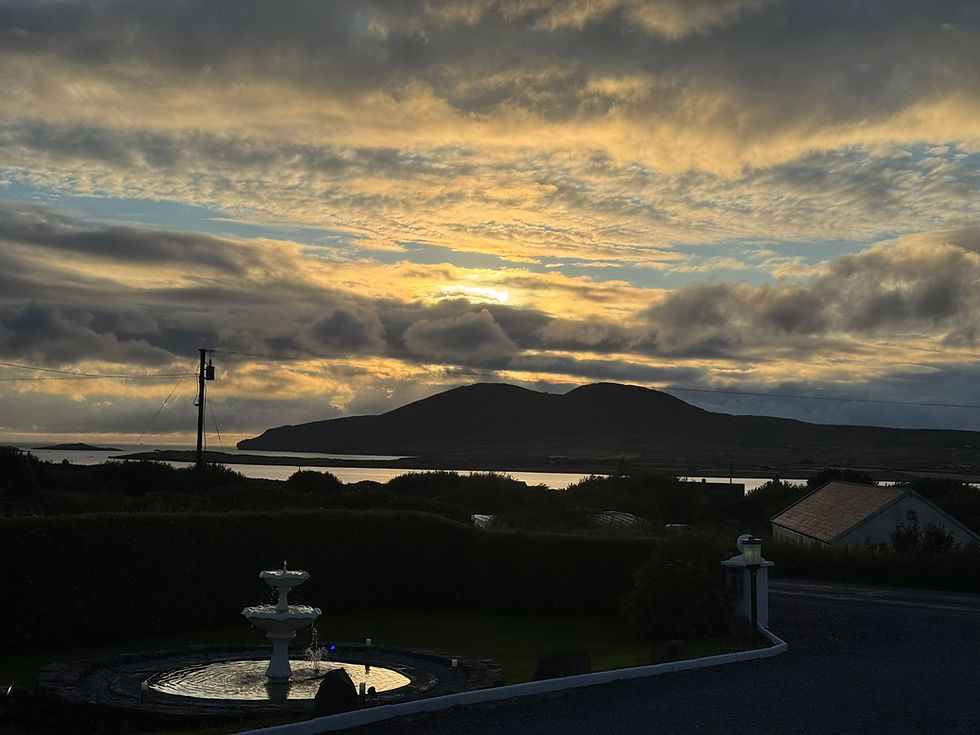
The B&B sat perched above the water, offering a view of the long Irish summer light. With sunset drifting past 10 p.m., the sky reflected off the Irish Sea below. Mountains rose quietly in the distance, as clouds moved lazily across the horizon. Standing there by the fountain, after a day of beautiful hike, made for a satisfying day.

Today was a 13.7 mile hike, about 22km, with 2,670 feet of elevation gain, that was comfortably between “not too hard” and “definitely not easy.” The route threw two steady hills at me. I set off at 8:30 a.m. with a seven‑hour goal in mind, settling quickly into that familiar rhythm of climbing, catching my breath, and letting the landscape reward the effort.
No rain today, just wide, rolling landscapes and greenery stretching as far as I could see. The trail had its share of steep, hilly sections, enough to keep the legs honest, and a few moments where I wandered off course and had to backtrack to find the markers again. But with clear skies overhead and Ireland showing off every shade of green it owns; it felt like the kind of day that rewards you simply for being out there.
Then came the day’s real scare. A cluster of massive cows stood directly in my path, each one easily looking like it weighed a ton. As I approached, they began moving toward me, slow at first, then with unsettling intent. I bolted uphill, huffing and puffing, heart thumping, absolutely convinced I was about to be trampled.
There was no one around, just me, the slope, and these giants blocking the trail. It happened twice more before I finally stopped to look it up and learned the strangest thing: cows have poor depth perception. They weren’t charging, they were just walking closer to figure out who I was and whether I would offer them a treat. A terrifying misunderstanding, but a very Irish one.
The rocky path continued for miles, shifting constantly between firm surface and stretches of deep, clinging mud, at one point my shoes sank nearly 30 cm into it, making every step a small battle.
The trail wound through shaded forest corridors, ferns brushing my legs, before opening suddenly into sweeping views of the ocean.
From high ridgelines, the Irish Sea shimmered below, dotted with small islands that looked almost casually scattered across the water. Every time the landscape opened up, I found myself stopping to take yet another photo, unable to resist the mix of green hills, blue water, and quiet, distant mountains. It was messy, muddy, and absolutely magnificent.
From high ridgelines, the Irish Sea shimmered below, dotted with small islands that looked almost casually scattered across the water. Every time the landscape opened up, I found myself stopping to take yet another photo, unable to resist the mix of green hills, blue water, and quiet, distant mountains. It was messy, muddy, and absolutely magnificent.

I walked through stretches of open meadow where delicate, cotton‑like flowers dotted the bright green grass, swaying gently in the breeze. After miles of rocky paths, muddy climbs, and sweeping ocean views, these soft white tufts felt almost otherworldly.
By 5 p.m., I finally reached the day’s endpoint, Waterville, a small, beautiful town resting right on the edge of the Atlantic. Pastel‑painted cottages lined the road as I walked in, each one neat and cheerful against the backdrop of sea and mountains. Down by the waterfront, two friends sat on a bench, their silhouettes framed by glittering water and the soft evening light.
Hunger hit me hard by then, and spotting The Lobster, the town’s highly acclaimed seafood spot, felt like a small miracle. I found a seat, enjoyed a well‑earned meal of fresh seafood, and then made my way to the B&B, ready to rest after a long, unforgettable day on the trail.
The next morning, after a solid breakfast and a good night’s rest, I allowed myself a leisurely start. The day’s walk to Caherdaniel was only 16 km, about four hours, so there was no rush, just the quiet pleasure of easing back onto the trail.
The air felt fresh, the light soft, and the pace unhurried, a welcome contrast to the previous day’s long push into Waterville. It was one of those rare hiking mornings where everything aligned: rested legs, good weather, and the comforting knowledge that the day ahead would be steady and gentle.

Walking by the infographic by the Ballinskelligs bay, I realized that the Kerry Way isn’t just a trail through beauty, it’s a walk through time. The bay was shaped by ancient glacial movement, its deep blue waters once serving as a natural harbor for early settlers and traders.
The surrounding hills reveal layers of sandstone and shale, reminders of Ireland’s tumultuous geological past. Along the route, remnants of ring forts and famine-era cottages evoke stories of resilience, while the boglands which are rich in peat and wild flora, mark centuries of coexistence between people and landscape.

Far beyond the mainland’s rolling hills, out in the bay, I could see Skellig Michael rising from the Atlantic like a jagged emerald crown. Its 618 stone steps, carved by hand over a millennium ago, lead to a monastery perched among beehive huts built by monks who sought solitude at the edge of the world. It’s no wonder Skellig Michael became the backdrop for the Jedi’s exile in Star Wars, its sheer cliffs and ancient stone dwellings feel utterly otherworldly. I wanted to visit it, but tickets sell out months in advance, so this mystical island will have to wait for a future trip.

The walk today was intensely scenic, where every few minutes the landscape shifted into something worth stopping for. Small green islands rose out of the water close to shore, while larger, darker silhouettes sat farther out on the horizon. The trail wound past Darrynane Harbour, calm and glassy, and I found myself looking forward to reaching Darrynane House, a rare chance for a proper food stop on this route, unlike the Camino de Santiago where cafés appear every few kilometers.
The trail into Derrynane turned into a tapestry of scenery, history, and small surprises woven together. It began with a cute dark tunnel that opened suddenly into a bright green cove, a little moment of magic before the coastline unfolded in front of me with small islands rising close to shore and larger, brooding shapes farther out.
I passed the Blue Flag beach, unusually crowded thanks to the rare warm, rain‑free Irish weather, and even before reaching Derrynane House I spotted a pastel‑yellow bar with a few people relaxing outside. A shot of local Skelligs whiskey and some cheerful conversation with the warm, smiling waitress put me in a buoyant mood for the next stretch.
Past Darrynane Harbour, the path led toward Derrynane House, once the home of Daniel O’Connell, the Liberator, whose legacy still echoes through the portraits, artifacts, and political memorabilia inside. Outside, the gardens, dunes, and even the conservation signs about the endangered Natterjack toad made it clear that this place is as alive in nature as it is in history.
The pretty outdoor refectory offered a perfect pause for a fresh mushroom soup and a sandwich, and as I continued on, the nearby forest revealed a few more fairy houses tucked among the trees.

Soon I reached the Blind Piper pub, the official end point for the day’s 28km (17.5 mile) hike that included a 1000-meter climb. After hours of sun, scenery, tunnels, coves, beaches, whiskey, history, and fairy houses, it felt like the perfect place to pause.
My B&B host was on his way to pick me up, his place was a few miles off the trail, so I took the time to unwind, sip some chilled sparkling water, and stretch out my legs. By the time my ride arrived, I was relaxed, content, and ready to call it a day.
Day 8 hike from Caherdaniel to Sneem was an easy, relaxed stretch of the Ring, just 17 km with a gentle 440 m of ascent, and I allowed myself a late start at 10 a.m. Michael, my B&B host, dropped me back at the Blind Piper pub, where I immediately ran into four Belgian hikers. We chatted for a bit before I naturally pulled ahead at a faster pace. The morning felt calm and unhurried, though a sign warning of a big bull in the area kept me alert as I moved through the fields. The path wound steadily toward Sneem, and before long I rolled into the town which was a cute, colorful place full of cafés, pubs, and little eateries, marking the end of another beautiful day on the trail.

I wandered around Sneem for a while, admiring its colorful storefronts and neatly painted houses, each one adding to the town’s cheerful charm. Sacre Coeur was billed as one of the best seafood spots in town, so I made myself a reservation and settled in later for a satisfying meal capped with a delicious dessert.
Day 9 walk from Sneem to Kenmare was the big one: 32 km, nearly 20 miles, with 690 meters of ascent, and I had a 5 p.m. dinner reservation at a Michelin‑guide restaurant waiting for me at the finish.
With that in mind, I planned to walk efficiently and set off at 8 a.m.
The walk was quiet, green, and deeply forested, with long stretches where the only sounds were my footsteps and the wind moving through the trees. Every so often the trail opened to wide views of the bay. I seemed to be the lone hiker that morning, moving steadily through the stillness.
Dromquinna Manor appeared like a quiet oasis at the edge of the bay, its grounds elegant and peaceful after the long-forested stretch. The waterfront café was especially lovely, set right by the water. I stopped for a small meal there, a perfect pause before tackling the final 5 km into Kenmare.
Kenmare welcomed me with its colorful storefront facades and a handsome stone church at the center of town. A huge number of tourists filled the streets, all seemingly enjoying the warm weather and lively atmosphere.
At my appointed time, I headed to Mulcahy’s for a well‑earned dinner, excellent food, beautifully prepared, and exactly the reward I’d been imagining since Sneem. After the meal, I walked back to my B&B for a much‑needed sleep. Tomorrow would be the final day of the hike, carrying me all the way back to where it all began in Killarney.

Many countryside Irish roads are astonishingly narrow, barely wide enough for two small cars to pass, so drivers constantly pull into little alcoves carved into the roadside to let oncoming traffic through.
The agricultural presence is huge, and throughout the day massive tractors, towering 15 to 20 feet high, wide as small buses, and bristling with farm equipment jutting out at odd angles, came thundering past at surprising speeds. I saw several of them rumble by, and whenever one approached from my direction, there was literally no space for me on the road. I had to step deep into the bushes, pressed against branches and brambles, just to avoid being clipped.
Day 10, Kenmare to Killarney, 24 km with 680 meters of ascent, felt partly familiar, as sections of the trail overlapped with the route I had walked on Day 1.
As I approached the edge of Killarney National Park, the day felt almost uncharacteristically hot for Ireland, bright, dry, and warm. At a bend in the path, I stopped to chat with a couple just beginning their hike, and they pointed out that the park service had set up a water cooler at the corner. I helped myself to icy cold water, filling my bottle to the brim, and the shock of cold against the heat was instantly refreshing. It was such a simple gesture, but in that moment, I felt genuinely grateful for the park service, one of those small kindnesses that makes a long day’s walk feel lighter.

The sight of the first jaunting car told me I was finally on the outskirts of Killarney, the familiar markers of civilization appearing after days of quiet countryside.
My long multi‑day hike was almost finished, and I felt a wave of gratitude wash over me. I had no blisters, the weather had been astonishingly good aside from one rainy day, and every Irish person I’d met had been kind, warm, and helpful.
The Guinness had been frothy, the food consistently delicious, the landscapes impossibly green, the lakes and bays shimmering in silvery light. As I walked the final stretch toward town, I realized I carried nothing but happy memories from the hike, ten days of beauty, effort, small surprises, and the gentle charm of Ireland.


Nice narration and excellent pictures hemant.